Anito-cel CAR T-Cell Therapy Delivers Deep, Durable Responses and High MRD-Negativity in Relapsed/Refractory Multiple Myeloma
 Pharm'Up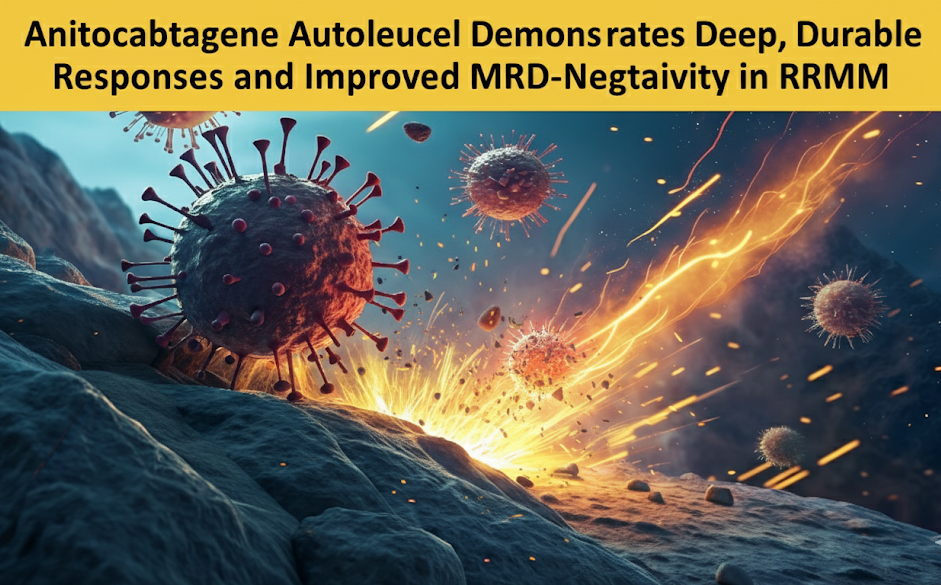
New data presented at the 2025 International Myeloma Society Annual Meeting in Toronto, Canada, has revealed that anitocabtagene autoleucel (anito-cel), an investigational BCMA-targeting CAR T-cell therapy from Arcellx, Inc, demonstrates impressive efficacy and a manageable safety profile in patients with heavily pretreated triple-class exposed relapsed/refractory multiple myeloma (RRMM). The findings from the Phase 2, open-label iMMagine-1 trial (NCT05396885) underscore the potential of anito-cel to provide deep, durable responses and high rates of minimal residual disease (MRD) negativity in this challenging patient population.
Anito-cel: A Next-Generation CAR T-Cell Therapy
Multiple myeloma treatment has seen significant advancements, particularly with the emergence of immunotherapies like CAR T-cell therapy. This personalized treatment involves genetically engineering a patient’s own T-cells to target specific cancer antigens, such as BCMA, which is frequently overexpressed on myeloma cells. Anito-cel is an autologous (patient’s own cells) CAR T-cell therapy that uniquely targets BCMA with a novel D-domain binder, distinguishing it from other CAR T options.
Key Results from the iMMagine-1 Trial
The iMMagine-1 trial enrolled patients with RRMM who had progressed after receiving three or more prior lines of therapy (LOT) and were triple-class exposed. Patients underwent lymphodepletion chemotherapy followed by a single infusion of anito-cel.
Key efficacy and safety outcomes after a median follow-up of 9.5 months (range, 2–23) for 86 patients (median 4 prior LoT, with 86% triple-class refractory and 43% penta-drug refractory) include:
- Overall Response Rate (ORR): An impressive 97% (83/86) achieved an overall response.
- Complete Response (CR) or Stringent Complete Response (sCR): Achieved by 62% (53/86) of patients.
- MRD Negativity: Among evaluable patients (n=58), 93.1% (54/58) achieved MRD negativity at a sensitivity of at least 10−5, with a median time to MRD negativity of only one month.
- Durability of Response (DoR): The 12-month DoR rate was 75.6%. Median DoR was not reached.
- Progression-Free Survival (PFS): The 12-month PFS rate was 78.5%. Median PFS was not reached.
- Overall Survival (OS): The 12-month OS rate was a robust 96.5%. Median OS was not reached.
Manageable Safety Profile
The safety profile of anito-cel was deemed manageable:
- Cytopenias: The most common grade 3 or higher treatment-emergent adverse events were cytopenias.
- Cytokine Release Syndrome (CRS): Occurred in 83% of patients (n=81), with the vast majority being low grade (68% grade 1, 13% grade 2). Only 1% experienced grade 5 CRS. Notably, 98% of patients either had no CRS or resolution within 14 days of infusion.
- Immune Cell-Associated Neurotoxicity Syndrome (ICANS): Rates were much lower at 9% (n=9), predominantly low grade (grade 1 or 2). No delayed or atypical neurotoxicities were observed.
These compelling results suggest that anito-cel could become a vital new treatment option for patients with RRMM, offering durable disease control and a high probability of achieving MRD negativity, which is often associated with improved long-term outcomes in multiple myeloma.
About the Author