Pharm'Up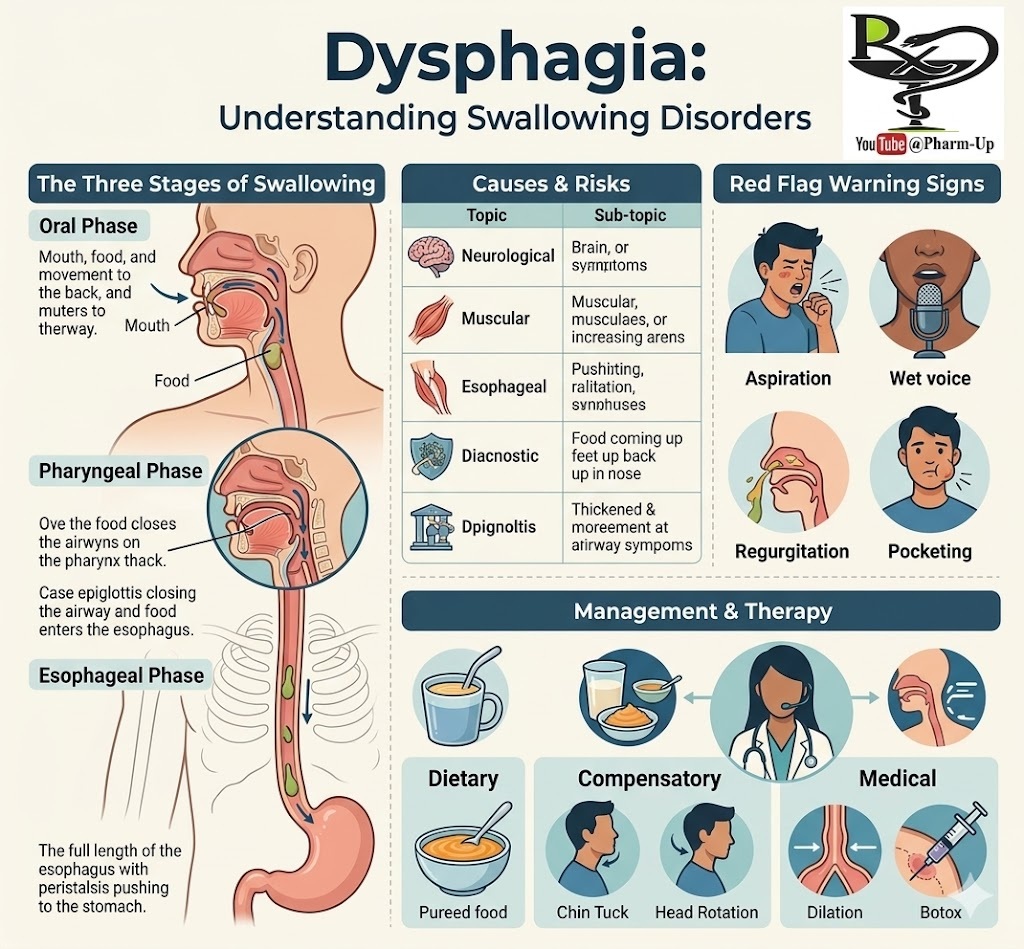
It sounds like you are looking at the fundamentals of Dysphagia, which is the medical term for swallowing disorders. It’s a complex process that most of us take for granted until something disrupts the coordination between the brain and the physical structures of the throat.
To help break down the information you provided, here is a more structured look at how these disorders manifest and are managed.
The Swallowing Process
Swallowing occurs in three main stages. A disorder can affect any one of these:
- Oral Phase: Preparing food in the mouth (chewing and moving it to the back).
- Pharyngeal Phase: The “point of no return” where the brain signals the airway to close and the food to move into the throat.
- Esophageal Phase: The muscles of the esophagus push the food down into the stomach.
Common Causes and Risks
As you noted, dysphagia is rarely a standalone “disease” but rather a symptom of an underlying neurological or structural issue.
| Category | Examples |
| Neurological | Stroke, Parkinson’s, Multiple Sclerosis (MS), or Traumatic Brain Injury. |
| Muscular | Muscular dystrophy or Achalasia (where the esophagus loses the ability to move food). |
| Structural | Narrowing of the esophagus (strictures), tumors, or esophageal webs. |
| Inflammatory | Severe GERD (acid reflux) causing scarring or inflammation. |
Warning Signs to Watch For
Beyond just “pain,” there are specific “red flag” behaviors that suggest a swallowing disorder:
- Aspiration: Food or liquid “going down the wrong pipe” into the lungs, often causing coughing or throat clearing during meals.
- Wet Voice: A gurgling sound in the voice after eating or drinking.
- Regurgitation: Food coming back up, sometimes through the nose.
- Pocketing: Keeping food hidden in the cheek because it’s too difficult to move to the throat.
Management and Therapy
Treatment is highly individualized depending on the cause. A Speech-Language Pathologist (SLP) is usually the lead clinician for rehabilitation.
1. Dietary Modifications
One of the most common interventions is changing the texture of intake to prevent choking or aspiration:
- Thickened Liquids: Using agents to make water or juice the consistency of nectar or honey so it moves slower and is easier to control.
- Pureed or Soft Foods: Reducing the need for complex chewing.
2. Compensatory Maneuvers
These are physical “hacks” to make swallowing safer:
- Chin Tuck: Tucking the chin toward the chest while swallowing to help close off the airway.
- Head Rotation: Turning the head to one side to direct food down the “stronger” side of the throat.
3. Medical Intervention
- Dilation: A procedure where a doctor stretches a narrowed area of the esophagus.
- Botox: Occasionally used to relax a sphincter muscle that is too tight to let food pass.
About the Author