US Releases FY2027 Major Drug Transit and Producing Nations List: India, China, and Pakistan Included Amid Heightened Scrutiny on Precursor Chemicals
 Pharm'Up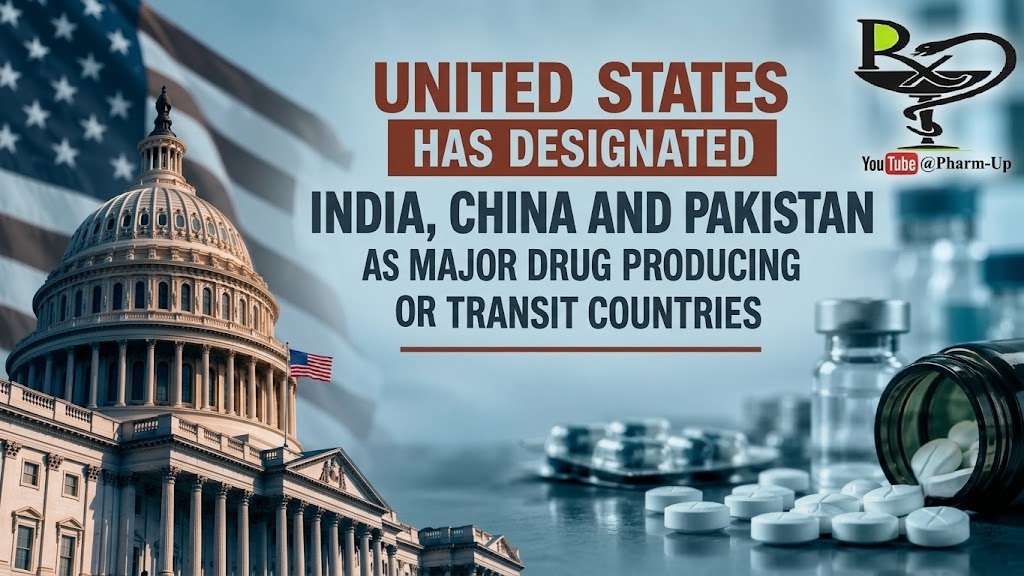
The United States has formally designated India, China, and Pakistan among 23 nations identified as major illicit drug-producing or drug-transit countries for fiscal year 2027. The annual assessment, known statutorily as the “Majors List,” was delivered to the U.S. Congress on September 15, 2026, under the foreign counternarcotics oversight framework.
India.com
The presidential determination identifies countries that function as key conduits or manufacturing sites for illicit narcotics and their essential chemical precursors entering American borders.
The White House
The 23 Designated Countries for FY2027 The full list submitted by the White House comprises:
- South Asia & Asia-Pacific: Afghanistan, Burma (Myanmar), China, India, Laos, Pakistan. GK Today
- The Americas & Caribbean: The Bahamas, Belize, Bolivia, Colombia, Costa Rica, Dominican Republic, Ecuador, El Salvador, Guatemala, Haiti, Honduras, Jamaica, Mexico, Nicaragua, Panama, Peru, and Venezuela. GK Today
Key Clarifications on Legal Status and Compliance Under U.S. counternarcotics law, an appearance on the Majors List does not automatically signify culpability, complicity, or insufficient enforcement by a host government. The designation is largely determined by geographic positioning, international shipping corridors, commercial infrastructure, and extensive industrial chemical manufacturing capacity that criminal syndicates attempt to exploit.
India.com+ 1
The U.S. framework distinguishes between broad transit or production status and a formal failure to cooperate:
- Demonstrable Non-Compliance Finding: For FY2027, the White House determined that only four countries—Afghanistan, Bolivia, Burma, and Colombia—had “failed demonstrably” to fulfill their international counternarcotics agreements over the preceding 12 months. India.com
- Cooperation Recognized for India: India, China, and Pakistan were not placed under the non-compliance finding. The determination specifically acknowledged India’s domestic actions to dismantle illicit opium poppy farming and reinforce supply-chain integrity, underscoring ongoing bilateral engagement through the U.S.–India Drug Policy Framework. India.com+ 1
Focus on Precursor Chemicals and the Legitimate Pharmaceutical Sector The classification carries direct implications for global supply chains, specifically regarding dual-use intermediate chemicals:
- No Embargo on Legitimate Pharma: The listing does not label or penalize India’s authorized pharmaceutical industry as illicit. Standard exports of finished dosage drugs, active pharmaceutical ingredients (APIs), and regulated medicines continue without trade sanctions.
- Diversion Control: U.S. drug control policy is sharply targeting the diversion of legitimate industrial chemicals into black-market synthetic drug production, including illicit fentanyl and methamphetamine. India.com
- Enhanced Traceability: Exporters, freight forwarders, and chemical manufacturers in transit hubs face elevated expectations regarding “Know Your Customer” (KYC) documentation, end-use monitoring, and customs verification to ensure synthetic drug precursors are intercepted before reaching illicit distribution pipelines.
About the Author