Skip to content
  • YouTube
  • Facebook
  • LinkedIn
Pharm'Up

Pharm'Up

An E-platform for Learners

https://www.youtube.com/watch?v=xuTKPPZrxy4
Primary Menu
  • Home
  • News
  • Industries
  • Disease
  • Drugs
  • Events
  • Jobs
  • Trainings
  • Conferences
  • Syllabus
  • Previous Papers
  • Notes
  • Colleges
Live
  • Home
  • 2026
  • January
  • 7
  • Understanding Heart Rhythm Devices: Pacemakers vs. ICDs
  • Disease

Understanding Heart Rhythm Devices: Pacemakers vs. ICDs

Pharm'Up 2 min read

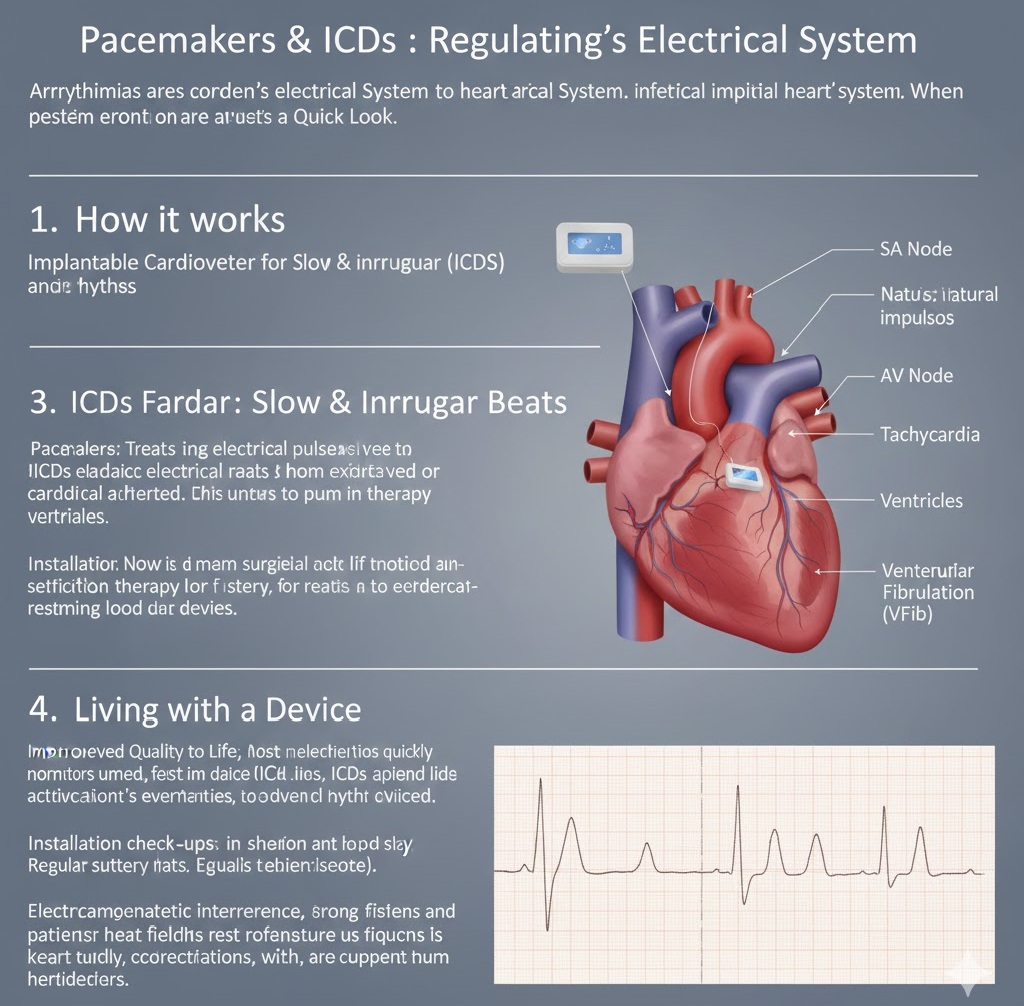
An arrhythmia is a disorder of the heart rate or rhythm, meaning the heart beats too quickly, too slowly, or with an irregular pattern. Most of these issues stem from the heart’s internal electrical system. When an arrhythmia becomes serious or life-threatening, doctors often recommend implantable devices to manage the heart’s rhythm.

What is a Pacemaker?

A pacemaker is a small device implanted in the chest or abdomen to help control abnormal heart rhythms. It acts like a metronome for the heart, using low-energy electrical pulses to:

  • Speed up a slow heart rhythm (bradycardia).
  • Help control a fast or irregular rhythm.
  • Coordinate the timing between the upper and lower chambers of the heart.

What is an ICD?

An Implantable Cardioverter Defibrillator (ICD) is a more advanced device designed to monitor heart rhythms constantly. Its primary job is to prevent sudden cardiac arrest (SCA).

  • Defibrillation: If the device senses a dangerously fast or chaotic rhythm, it delivers a high-energy shock to “reset” the heart.
  • Monitoring: Many ICDs record the heart’s electrical patterns, providing valuable data for doctors to refine future treatments.
  • Dual Function: Most modern ICDs also function as pacemakers, providing steady pacing when needed and emergency shocks only when necessary.

Comparison at a Glance

FeaturePacemakerICD
Main FunctionMaintains a steady, “normal” heart rate.Prevents sudden death from lethal rhythms.
Correction MethodLow-energy electrical pulses (usually unfelt).High-energy shocks (defibrillation).
Ideal ForChronic slow heartbeats or heart block.High risk of cardiac arrest or racing heart.

The Procedure and Recovery

Getting either device involves minor surgery, typically requiring a one-to-two-day hospital stay for observation.

  1. Implantation: The device is placed under the skin, and leads (wires) are threaded through veins into the heart.
  2. Testing: Doctors ensure the device responds correctly to your heart’s specific needs.
  3. Recovery: Most patients return to their normal daily activities within a few days, though heavy lifting is usually restricted for a few weeks to allow the site to heal.

About the Author

Pharm'Up

Author

An E-platform for Pharma Learners

View All Posts

Post navigation

Previous: Understanding Deep Vein Thrombosis (DVT)
Next: Diabetes and Foot Care: Prevention and Management

Related Stories

Pharmup 21
2 min read
  • Disease

Hepatitis A: Acute Viral Infection and Prevention

Pharm'Up
Pharmup 20
1 min read
  • Disease

Hepatitis: Understanding Liver Inflammation and Its Causes

Pharm'Up
Pharmup 19
1 min read
  • Disease

Liver Transplantation: A Lifesaving Procedure

Pharm'Up

Recent Posts

  • HLL Lifecare Limited Recruitment 2026: Pharmacist Trainee Openings
  • Junior Research Fellow (JRF) Opportunity at HNB Garhwal University
  • CSIR-CCMB Empanelment 2026: Opportunities for Pharmacy & Life Sciences Professionals
  • Clinical Pharmacologist Recruitment 2026: Homi Bhabha Cancer Hospital (TMC)
  • Junior Research Fellow (JRF) Opportunity at BITS Pilani, Hyderabad Campus

Recent Comments

No comments to show.

Archives

  • April 2026
  • March 2026
  • February 2026
  • January 2026
  • December 2025
  • November 2025
  • October 2025
  • September 2025
  • August 2025
  • July 2025

Categories

  • Colleges
  • Conferences/ Workshops
  • Disease
  • Drugs
  • Events
  • Industries
  • Notes
  • Pharma Jobs
  • Pharma News
  • Previous Papers
  • Syllabus
  • Trainings/ Courses
  • Uncategorized

Read These Too

Pharmup 22
2 min read
  • Pharma Jobs

HLL Lifecare Limited Recruitment 2026: Pharmacist Trainee Openings

Pharm'Up
Pharmup 20
2 min read
  • Pharma Jobs

Junior Research Fellow (JRF) Opportunity at HNB Garhwal University

Pharm'Up
Pharmup 19
2 min read
  • Pharma Jobs

CSIR-CCMB Empanelment 2026: Opportunities for Pharmacy & Life Sciences Professionals

Pharm'Up
Pharmup 18
2 min read
  • Pharma Jobs

Clinical Pharmacologist Recruitment 2026: Homi Bhabha Cancer Hospital (TMC)

Pharm'Up
  • YouTube
  • Facebook
  • LinkedIn
Copyright ©Pharm'UP All rights reserved by Eduversity India | MoreNews by AF themes.