Pharm'Up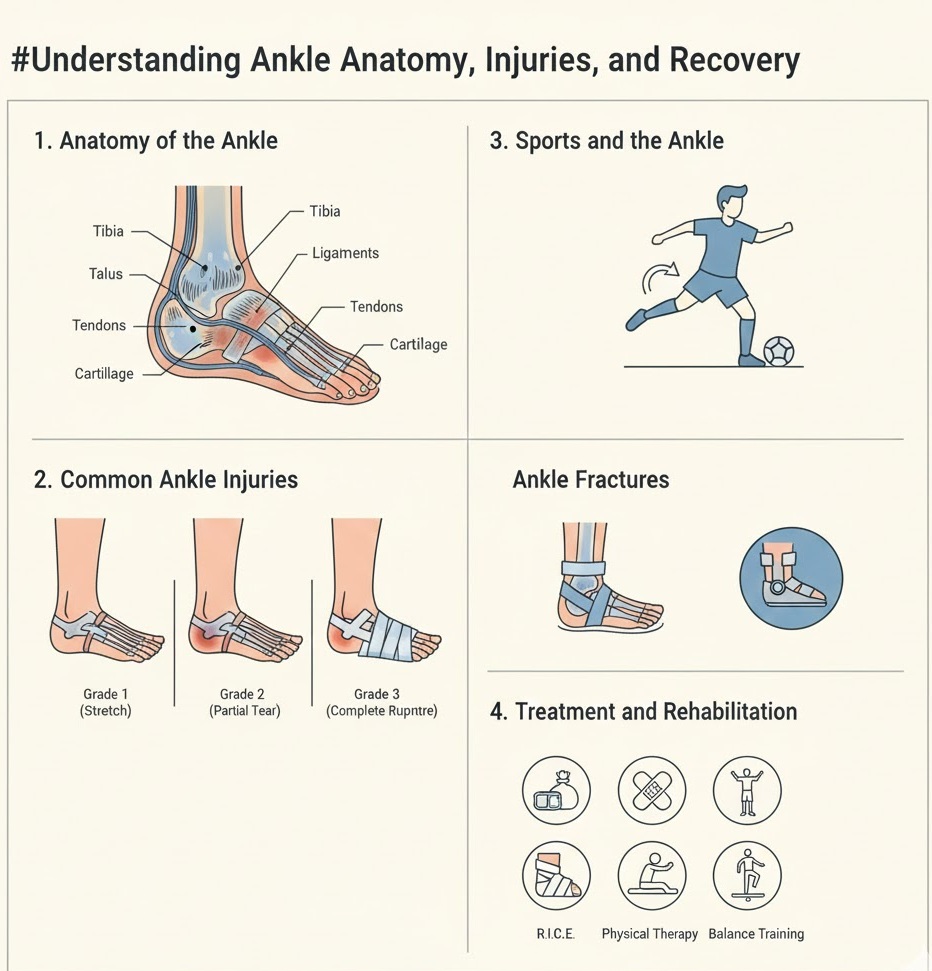
The ankle is a complex, weight-bearing hinge joint that provides balance and allows for the multi-directional movement required for walking, running, and jumping. Because it supports the entire weight of the body, it is one of the most frequently injured areas in both athletes and the general population.
1. Anatomy of the Ankle
The ankle is not a single bone, but a meeting point of three bones held together by a network of supportive tissues.
- The Bones: The joint consists of the talus (ankle bone) and the two bones of the lower leg: the tibia (shin bone) and the fibula (the smaller outer bone).
- Ligaments: These tough, elastic bands connect bone to bone. They are the primary stabilizers that prevent the ankle from “rolling” too far.
- Tendons: These connect muscles to the bones, allowing you to flex and point your foot.
- Cartilage: A smooth, slippery coating on the ends of the bones that acts as a shock absorber and allows for friction-free movement.
2. Common Ankle Injuries
Most ankle issues fall into two categories: soft tissue damage or structural bone damage.
Ankle Sprains
A sprain occurs when the ankle is twisted or turned awkwardly, stretching or tearing the ligaments.
- Symptoms: Swelling, bruising, and pain when putting weight on the foot.
- Recovery: Depending on the severity (Grade 1 to 3), healing can take anywhere from a few weeks to several months.
Ankle Fractures
A fracture is a partial or complete break in one or more of the bones making up the ankle joint.
- Cause: Often caused by a high-impact fall, a car accident, or a severe twisting injury during sports.
- Difference from Sprains: While symptoms are similar to a sprain, a fracture often involves immediate, intense pain and a visible deformity or inability to move the joint at all.
3. Sports and the Ankle
Ankle injuries are among the most common sports injuries. Activities that involve rapid “cut” movements, jumping, or running on uneven surfaces (like soccer, basketball, and trail running) put the highest amount of stress on the ankle ligaments and tendons.
4. Treatment and Rehabilitation
Early intervention is key to preventing chronic ankle instability.
| Method | Purpose |
| R.I.C.E. | Rest, Ice, Compression, and Elevation to manage initial swelling. |
| Immobilization | Using a brace, walking boot, or cast to allow bones or ligaments to knit back together. |
| Physical Therapy | Exercises to restore range of motion and strengthen the muscles surrounding the joint. |
| Balance Training | Specifically designed to retrain the “proprioception” (the brain’s awareness of joint position) to prevent future falls. |
About the Author