Pharm'Up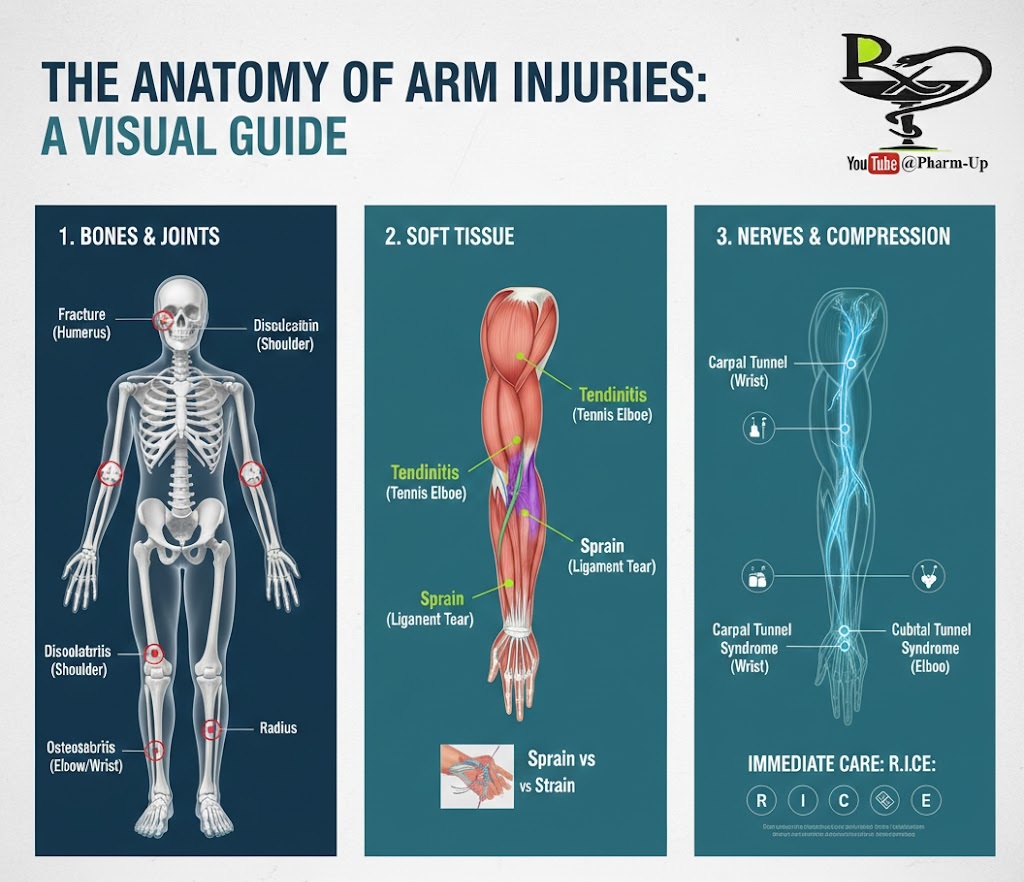
The human arm is a mechanical marvel of 3 bones, dozens of muscles, and intricate nerve networks. When things go wrong, they usually fall into one of these categories:
1. Structural Injuries (Bones and Joints)
- Fractures: Breaks in the humerus (upper arm), radius, or ulna (forearm). These can be “simple” (clean break) or “compound” (bone pierces the skin).
- Dislocations: Occur when the bone is forced out of its socket, most common in the shoulder and elbow. This often stretches or tears the surrounding ligaments.
- Osteoarthritis: While we often think of the knees or hips, the joints in the fingers, wrists, and elbows can lose their protective cartilage over time, leading to bone-on-bone friction.
2. Soft Tissue Injuries (Tendons, Ligaments, and Muscles)
- Sprains vs. Strains: A sprain is an injury to a ligament (connects bone to bone), while a strain is an injury to a muscle or tendon (connects muscle to bone).
- Tendinitis: Chronic overuse leads to tiny tears and inflammation in the tendons. Common examples include Tennis Elbow (lateral epicondylitis) or Golfer’s Elbow.
- Bursitis: Inflammation of the small, fluid-filled sacs (bursa) that cushion the joints. It often feels like a dull ache or “warmth” around the shoulder or elbow.
3. Neurological Issues (Nerves)
- Carpal Tunnel Syndrome: Compression of the median nerve in the wrist, causing numbness and tingling in the hand.
- Cubital Tunnel Syndrome: Compression of the ulnar nerve at the elbow (the “funny bone” nerve).
- Pinched Nerves: Often originating in the neck (cervical spine) but radiating pain all the way down to the fingertips.
Comparison of Common Arm Injuries
| Injury Type | Primary Cause | Key Symptom |
| Fracture | Sudden impact/falls | Immediate swelling, deformity, inability to move. |
| Tendinitis | Repetitive motion | Pain that increases during or after activity. |
| Dislocation | Trauma/Sports | Visual misalignment and intense joint pain. |
| Nerve Compression | Prolonged pressure | Tingling, numbness, or “pins and needles.” |
Prevention and Immediate Care (R.I.C.E.)
For most non-emergency arm injuries (sprains and strains), doctors recommend the R.I.C.E. method for the first 48 hours:
- Rest: Avoid activities that cause pain.
- Ice: Apply cold packs for 20 minutes at a time.
- Compression: Use an elastic bandage to reduce swelling.
- Elevation: Keep the arm above the level of your heart.
About the Author