Pharm'Up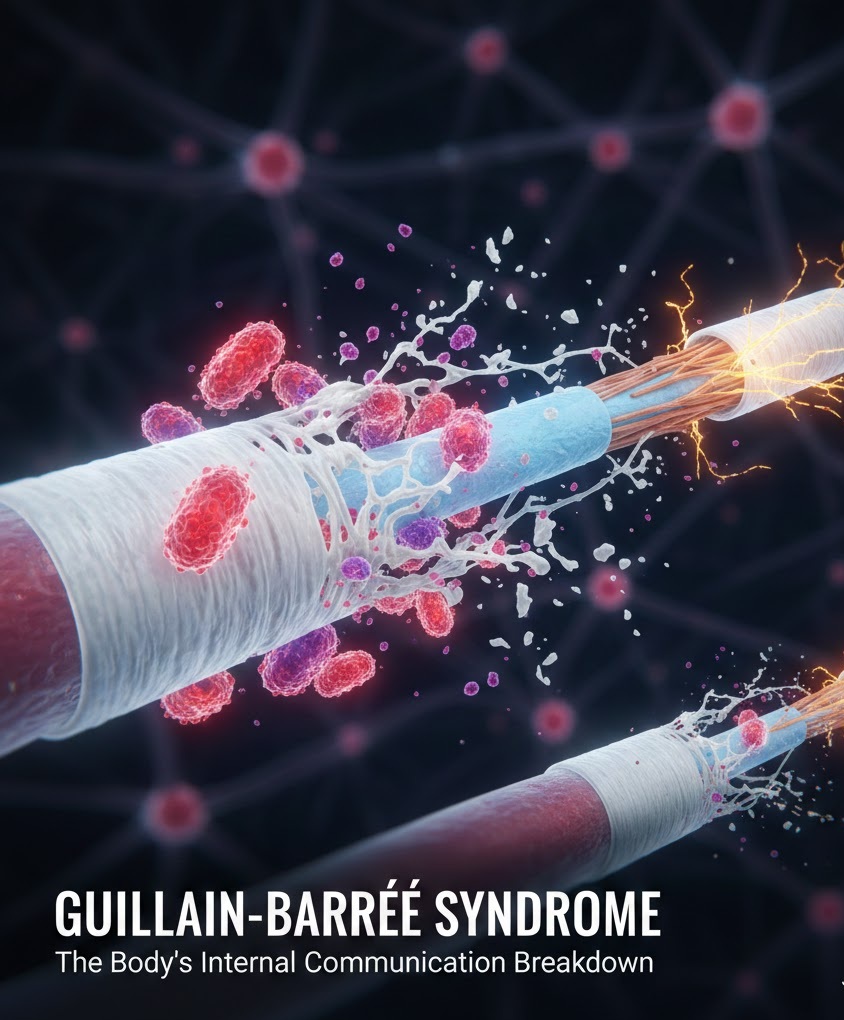
Guillain-Barré Syndrome (GBS) is a rare but serious condition where the immune system—the body’s natural defense against invaders—accidentally turns its fire on the Peripheral Nervous System (PNS). To understand GBS, it helps to view your body as a high-speed data network where the “cables” are suddenly compromised.
The Mechanics of the Attack
The primary target in GBS is often the myelin sheath, a protective fatty coating that surrounds nerve fibers.
- The Insulation Factor: Just like rubber coating on an electrical wire, myelin ensures signals travel fast and reach their destination.
- The Damage: When the immune system strips away this coating (a process called demyelination), nerve signals become sluggish, garbled, or stop entirely.
Symptoms and Progression
GBS is known for its symmetrical nature, meaning it usually affects both sides of the body equally, starting from the extremities and moving inward.
- The Ascent: It typically begins as a tingling or “crawling” sensation in the toes and fingertips.
- The Weakness: This evolves into muscle weakness that migrates up the legs toward the torso.
- The Crisis: In severe cases, the paralysis reaches the chest muscles, making it impossible to breathe without the aid of a mechanical ventilator.
The “Why” Behind the Confusion
While the exact cause is elusive, medical science points toward Molecular Mimicry. This occurs when a person is exposed to a virus or bacteria (most commonly Campylobacter jejuni) that has protein structures very similar to human nerve cells. The immune system, in its effort to kill the germ, fails to distinguish between the “invader” and the “host.”
Diagnosis and Modern Treatment
Because it is rare, doctors must rule out other neurological issues through:
- Spinal Tap: Checking for elevated protein levels without a high white blood cell count.
- Electromyography (EMG): Measuring the electrical activity in muscles to see if the “wiring” is faulty.
Treatment focuses on “resetting” the immune system. This is done either through Plasmapheresis (filtering the blood to remove rogue antibodies) or Intravenous Immunoglobulin (IVIG) (infusing healthy antibodies to neutralize the harmful ones).
The Road to Recovery
Unlike many neurological disorders, the prognosis for GBS is generally positive. The body has a remarkable ability to remyelinate, or regrow the insulation around the nerves.
- Timeline: Most patients reach their weakest point within 3–4 weeks.
- Rehabilitation: Physical therapy is crucial to keep muscles flexible and strong while the nerves repair themselves.
About the Author