Pharm'Up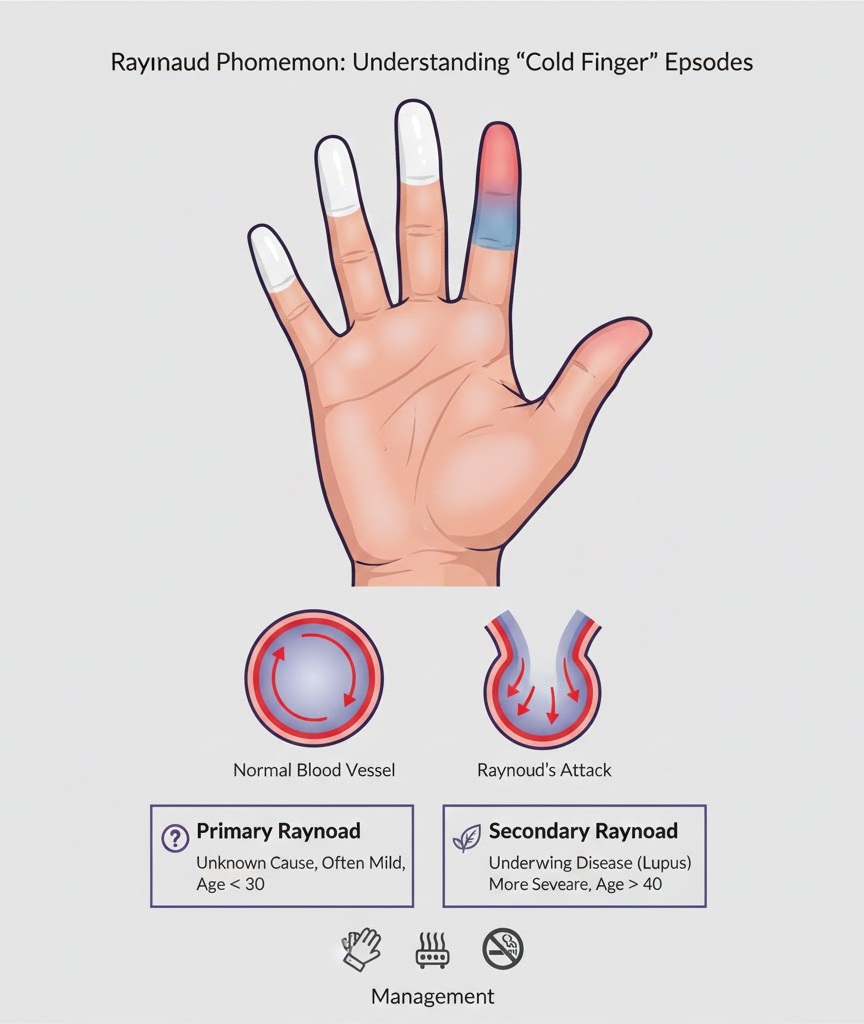
What is Raynaud Phenomenon?
Raynaud phenomenon is a condition where the small blood vessels in the extremities—most commonly the fingers and toes—overreact to cold temperatures or emotional stress. This overreaction causes the vessels to constrict (narrow) suddenly, severely limiting blood flow.
An episode is often called an “attack” and typically follows a three-color sequence:
- White: Lack of blood flow makes the skin pale.
- Blue: Lack of oxygen causes a bluish tint.
- Red: As the area warms and blood rushes back, the skin may turn red and tingle.
Primary vs. Secondary Raynaud
Not all cases of Raynaud are the same. Doctors classify them into two distinct types:
| Feature | Primary Raynaud | Secondary Raynaud |
| Commonality | Most common; often mild. | Less common; can be severe. |
| Cause | Unknown (Idiopathic). | Linked to an underlying disease (e.g., Lupus, Scleroderma). |
| Onset Age | Usually between ages 15 and 30. | Often appears after age 40. |
| Risk Factors | Being female, family history. | Chemical exposure, vibrating tools, or certain meds. |
Managing the Attacks
While there is no cure, the goal of treatment is to reduce the frequency and severity of attacks to prevent tissue damage (like skin ulcers).
- Immediate Action: During an attack, move to a warmer area, wiggle your fingers/toes, or place hands under armpits or warm (not hot) water.
- Trigger Avoidance: Avoid rapid temperature changes (like air-conditioned aisles in grocery stores) and manage stress levels.
- Lifestyle Choices: Quit smoking, as nicotine causes blood vessels to constrict, worsening the condition.
- Medical Help: If lifestyle changes aren’t enough, a doctor (often a rheumatologist) may prescribe blood pressure medications that help dilate (open) blood vessels.
When to See a Doctor
While Primary Raynaud is usually just a nuisance, you should seek medical advice if:
- Symptoms are strictly on one side of the body.
- You develop sores or ulcers on your fingertips or toes.
- Your symptoms start later in life (after age 30).
About the Author