Pharm'Up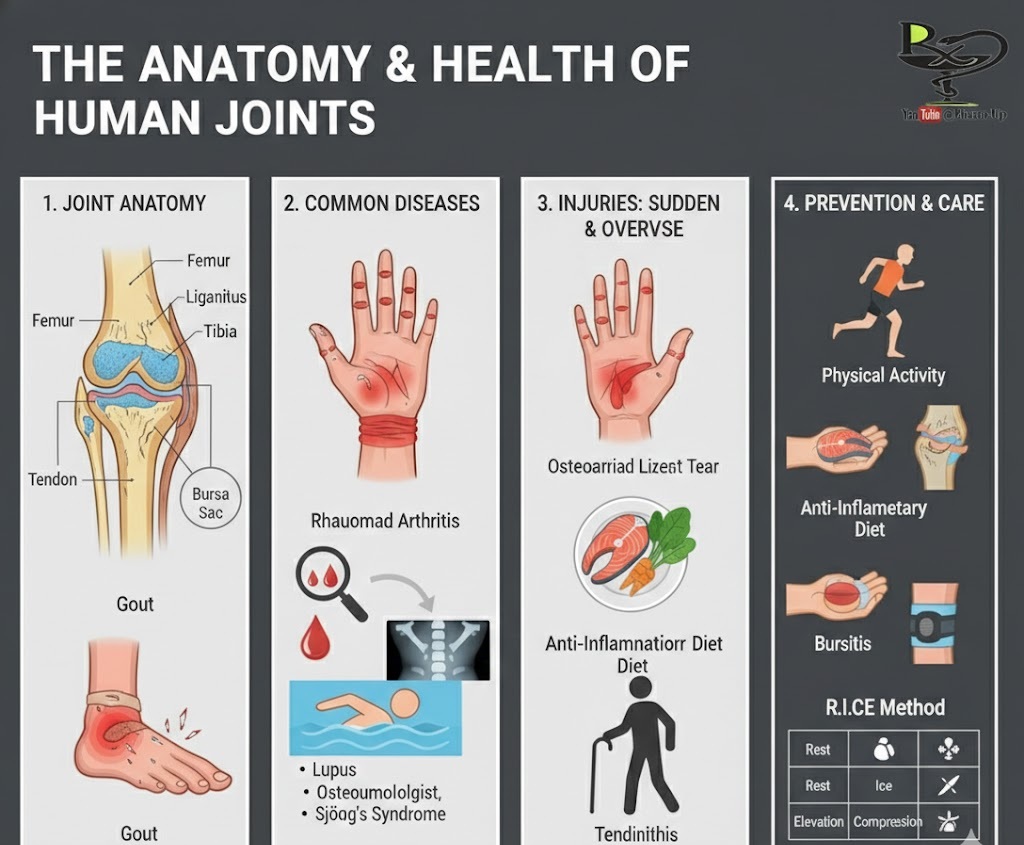
Joints are the functional intersections of the skeletal system, acting as the pivot points that allow the human body to move, bend, and rotate. They are complex structures comprised of much more than just bone; they are a delicate balance of hard and soft tissues working in harmony.
1. The Anatomy of a Joint
To understand joint disorders, it is helpful to look at the individual components that make movement possible:
- Bones: The structural foundation where two or more parts of the skeleton meet.
- Cartilage: A smooth, slippery tissue that acts as a shock absorber, preventing bones from rubbing directly against each other.
- Ligaments: Strong, elastic bands that connect bone to bone, providing stability and preventing the joint from moving in directions it shouldn’t.
- Tendons: Fibrous cords that connect muscle to bone, allowing the force of a muscle contraction to move the joint.
- Bursa: Small, fluid-filled sacs that act as cushions between bones and overlying soft tissues (muscles/skin) to reduce friction.
2. Common Diseases Affecting Joints
Many joint issues are “chronic,” meaning they persist over a long period and are often driven by inflammation or autoimmune responses:
- Osteoarthritis: The “wear-and-tear” disease where cartilage breaks down over time.
- Lupus: A systemic autoimmune disease where the body’s defense system attacks various tissues, frequently resulting in joint and muscle pain.
- Sjögren’s Syndrome: While primarily known for causing dry eyes and mouth, this condition commonly leads to significant joint stiffness and discomfort.
3. Injuries: Sudden vs. Overuse
Joint problems aren’t always caused by disease; they are frequently the result of physical trauma or repetitive stress.
Sudden (Acute) Injuries
These are usually the result of a single “event,” such as a fall or collision.
- Sprains: Specifically involve the stretching or tearing of ligaments.
- Dislocations: A medical emergency where bones are physically forced out of their normal position.
Overuse (Chronic) Injuries
These develop slowly as a result of repeating the same motion—common in athletes, musicians, and manual laborers.
- Bursitis: Inflammation of the bursa sac, often feeling like a warm, tender swelling.
- Tendinitis: Irritation of the tendon, making it painful to pull or move the associated muscle.
4. Comparison of Injury Types
| Injury Type | Primary Tissue Affected | Key Cause |
| Sprain | Ligament | Sudden twist or impact |
| Strain | Muscle or Tendon | Overstretching or lifting |
| Bursitis | Bursa Sac | Repetitive friction/pressure |
| Tendinitis | Tendon | Repetitive motion/Overuse |
5. Maintenance and Prevention
The “Use it or Lose it” rule applies heavily to joints. Physical activity is the primary way to maintain joint health because strong muscles take the “load” off the joint itself. Additionally, using protective gear (like knee pads or wrist guards) during high-risk activities can prevent life-long chronic issues.
About the Author