Pharm'Up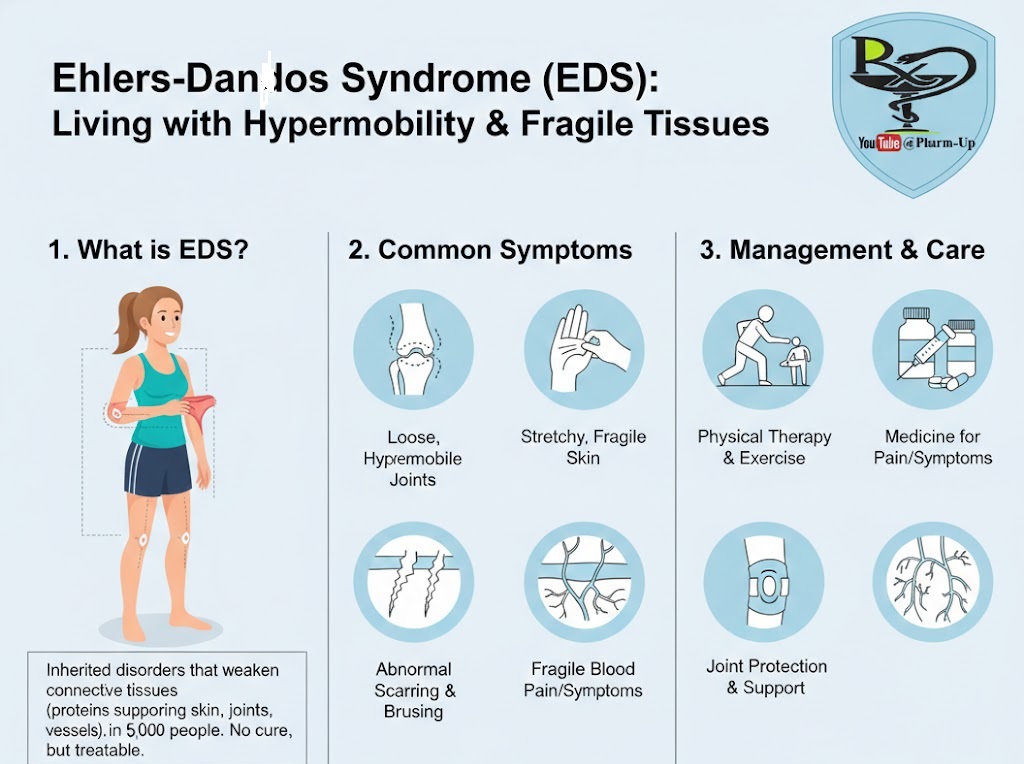
Ehlers-Danlos syndrome (EDS) is a group of inherited disorders that affect the connective tissues—the vital proteins that provide structure and support to your skin, bones, blood vessels, and internal organs. When these tissues are weakened, it impacts the body’s “glue,” leading to a range of systemic symptoms.
1. Key Symptoms and Characteristics
Because connective tissue is found throughout the body, EDS can present in several ways, often varying in severity from mild to life-threatening:
- Joint Hypermobility: Joints that are loose and have an unusually large range of motion, making them prone to dislocations and chronic pain.
- Skin Hyperextensibility: Skin that feels soft and velvety and is significantly stretchier than normal.
- Tissue Fragility: Skin that bruises easily and may heal poorly, often resulting in thin, “cigarette-paper” scars.
- Vascular Vulnerability: In certain types, blood vessel walls and organs can be fragile, increasing the risk of serious complications.
2. Prevalence and Diagnosis
EDS affects approximately 1 in 5,000 people. Because it is an inherited (genetic) condition, diagnosis often involves a combination of clinical physical exams, family medical history, and genetic testing to identify the specific type of EDS.
3. Living with EDS
While there is currently no cure, the focus of medical care is on protecting the body and managing symptoms:
- Physical Therapy: Specialized exercises to strengthen the muscles around joints to improve stability.
- Pain Management: Medications to help with chronic joint or muscle pain.
- Injury Prevention: Learning techniques to avoid overextending joints and protecting the skin from trauma.
- Regular Monitoring: Especially for those with vascular types, to check for potential issues with blood vessels or organs.
About the Author