Pharm'Up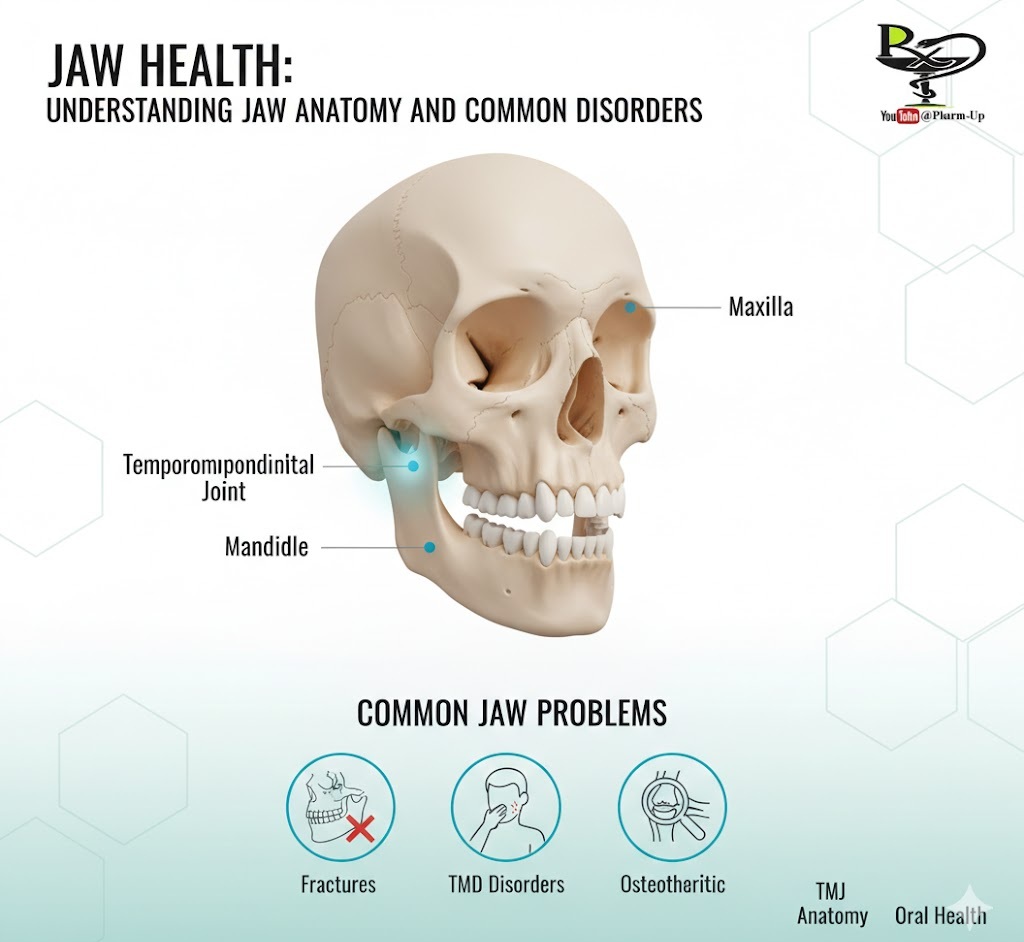
The jaw is a complex and highly active structural system that enables essential functions like eating, speaking, and breathing. It consists of more than just bone; it is a mechanical framework involving fixed structures, mobile hinges, and specialized joints.
The Anatomy of the Jaw
The human jaw is comprised of three primary components that work in unison:
- The Maxilla: The upper jaw bone. It is fixed to the skull and remains stationary. It supports your nose, the roof of your mouth, and holds your upper teeth.
- The Mandible: The lower jaw bone. This is the only mobile bone in the skull. It allows for the opening and closing of the mouth and houses your lower teeth.
- The Temporomandibular Joints (TMJ): These are the two hinges located just in front of your ears. They allow the mandible to slide and rotate, providing the flexibility needed for chewing and talking.
Common Jaw Problems & Conditions
Because the jaw is constantly in use, it is prone to several types of injuries and disorders:
| Condition | Description |
| TMD/TMJ Disorders | Problems affecting the jaw joints and surrounding muscles, often causing “clicking” or pain. |
| Fractures & Dislocations | Usually caused by trauma; a dislocation occurs when the mandible is pulled out of the TMJ socket. |
| Osteonecrosis | A serious condition where bone tissue dies due to a lack of blood supply. |
| Jaw Tumors | Abnormal growths within the jawbone or soft tissue, which can be benign or malignant. |
| Congenital Defects | Structural issues present at birth where the jaw may be underdeveloped or misaligned. |
Diagnosis and Care
Identifying the source of jaw pain typically involves Diagnostic Imaging such as X-rays, CT scans, or MRIs to visualize the bone density and joint alignment. Treatment varies widely based on the diagnosis, ranging from simple rest and mouthguards to complex oral surgery.
About the Author