Pharm'Up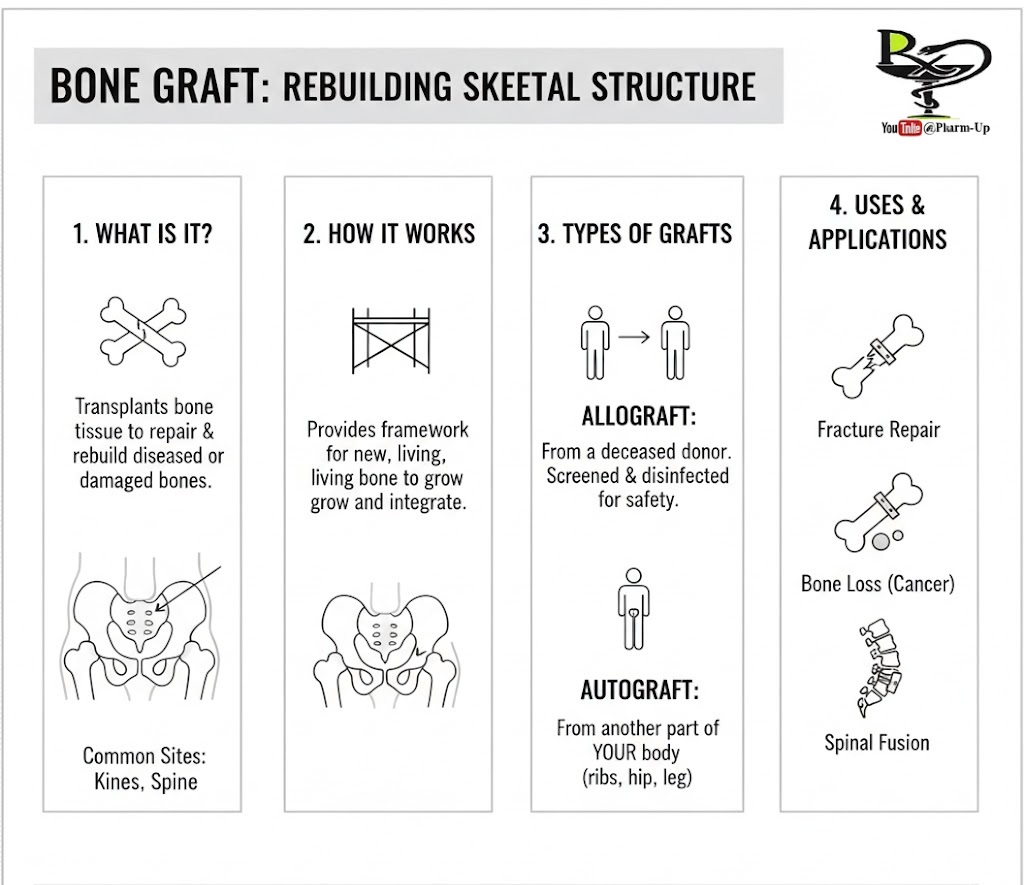
A bone graft is a surgical procedure that transplants bone tissue to repair, rebuild, or stabilize the skeletal system. This procedure is vital for treating complex injuries and degenerative conditions where the body cannot heal the bone on its own.
1. Why Bone Grafts Are Necessary
Surgeons utilize bone grafting for several critical medical reasons:
- Repairing Fractures: For complex or “non-union” breaks that fail to heal properly.
- Reconstruction: Rebuilding diseased bones or joints in the hips, knees, and spine.
- Bone Loss Recovery: Replacing bone tissue lost due to infections or certain types of bone cancers.
- Spinal Fusion: Helping two vertebrae grow together into one solid bone to treat instability or pain.
2. How It Works: The Biological Scaffold
The primary goal of a graft is to provide a “scaffold.” Once the transplanted tissue is in place, it creates a framework that your body’s own living cells use to grow and bridge the gap with new, healthy bone.
3. Types of Bone Grafts
There are two main sources for the transplanted bone tissue:
| Type | Source | Key Features |
| Autograft | Your own body | Taken from areas like the ribs, hips, or legs. Since it’s your own tissue, there is no risk of rejection. |
| Allograft | A human donor | Usually comes from deceased donors. Tissue banks strictly screen, disinfect, and test the bone to ensure safety and prevent infection. |
4. Recovery and Integration
Successful grafting depends on the body “accepting” the tissue. Over time, the graft is integrated into the natural bone through a process called osteoconduction, eventually becoming a permanent, strong part of the patient’s skeleton.
About the Author