Pharm'Up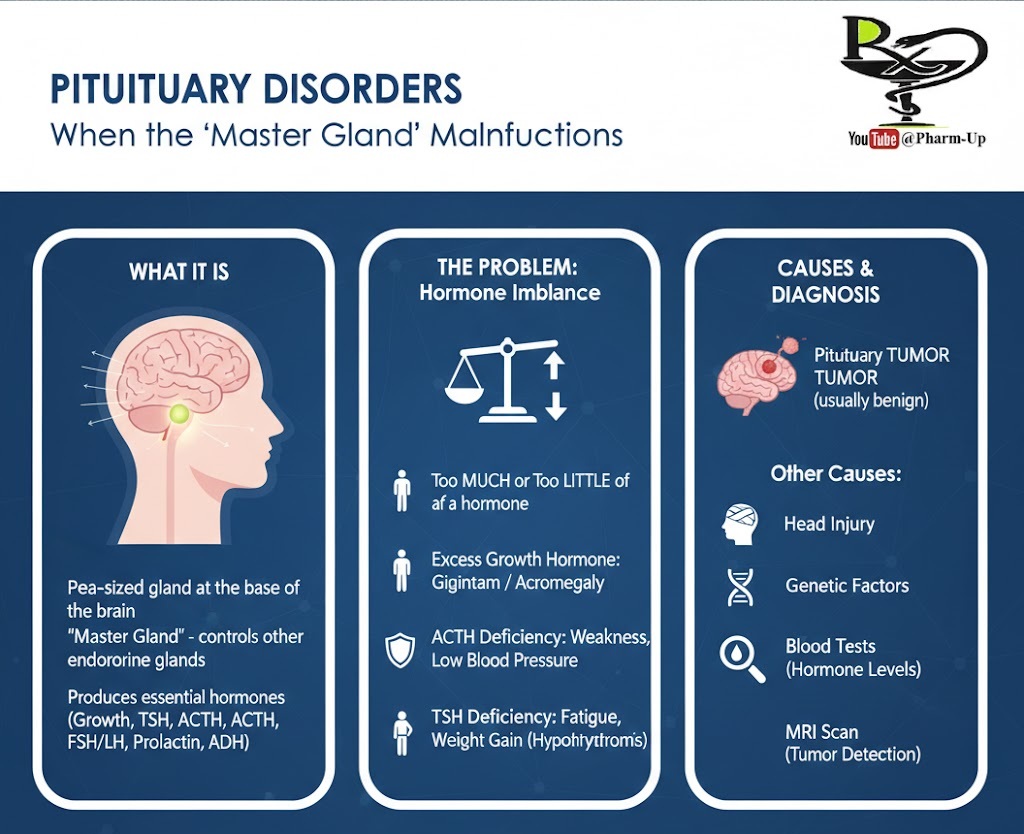
The pituitary gland is a small, pea-sized organ located at the base of the brain, right behind the bridge of your nose. Despite its tiny size, it is often called the “Master Gland” because it produces hormones that control several other hormone-secreting glands, including the thyroid, adrenals, and reproductive organs.
Understanding the “Master Control”
The pituitary gland acts as the body’s control center, regulating vital functions such as:
- Growth: Through Growth Hormone (GH).
- Blood Pressure: By managing water balance in the kidneys.
- Metabolism: By signaling the thyroid gland.
- Reproduction: By regulating estrogen and testosterone levels.
What Goes Wrong?
Pituitary disorders typically involve the gland producing either too much (hypersecretion) or too little (hyposecretion) of a specific hormone.
- Pituitary Tumors: The most common cause. Most are adenomas, which are benign (non-cancerous) but can interfere with hormone production or press against the optic nerves, causing vision problems.
- Hypopituitarism: A condition where the gland fails to produce enough of one or more hormones, leading to fatigue, weakness, or growth issues.
- Acromegaly/Gigantism: Caused by an overproduction of growth hormone, leading to excessive growth of bones and tissues.
- Cushing’s Disease: Occurs when a tumor causes the gland to produce too much ACTH, leading to excess cortisol (the stress hormone).
Diagnosis and Management
Diagnosis
Because symptoms often mimic other conditions, diagnosis requires specialized testing:
- Blood & Urine Tests: To measure specific hormone levels.
- MRI Scans: To visualize the gland and detect the presence of tumors.
- Vision Testing: To check if a tumor is pressing on the optic nerves.
Treatment
- Medication: To block excess hormone production or replace missing hormones.
- Surgery: Often performed through the nose (transsphenoidal surgery) to remove a tumor.
- Radiation Therapy: Used to shrink tumors that cannot be fully removed by surgery.
About the Author