DTAB Reaffirms Registered Pharmacist Mandate for Wholesale Drug Licences, Dropping Experience-Based Route
 Pharm'Up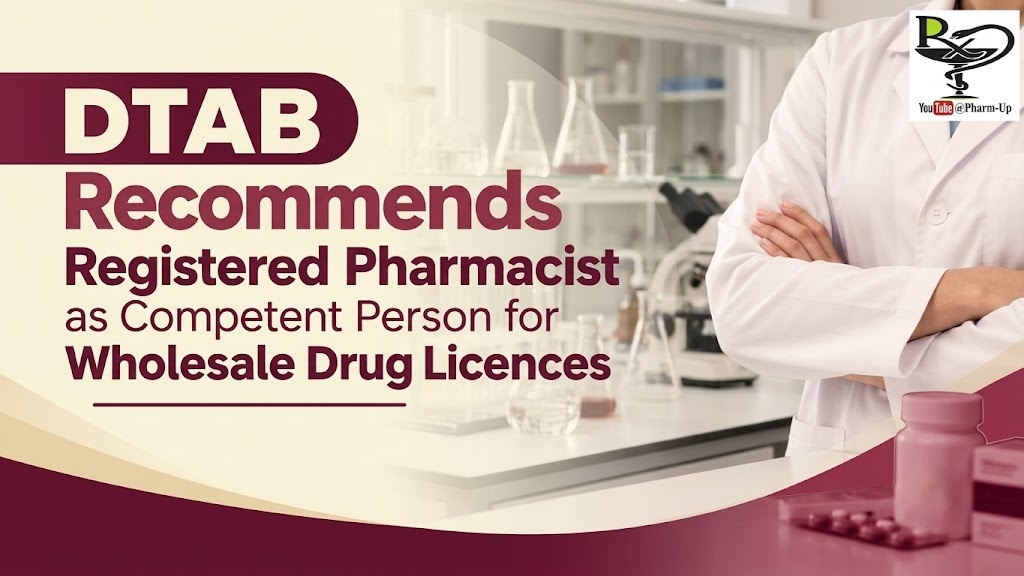
In a landmark decision for the pharmaceutical distribution sector, the Drugs Technical Advisory Board (DTAB) has reiterated its recommendation to mandate a Registered Pharmacist as the sole eligible competent person overseeing wholesale drug licences under Form 20B and Form 21B of Rule 64, Drugs Rules, 1945.
The decision, recorded during the Board’s 94th meeting, effectively steps back from an earlier proposal to allow non-pharmacy science graduates with bridge training to supervise wholesale distribution operations.
Key Highlights
- Sole Competent Person: DTAB recommends that only Registered Pharmacists qualify under Rule 64 for wholesale drug distribution (Forms 20B and 21B).
- Earlier Alternative Shelved: The previous consideration from the 93rd meeting—permitting Science graduates with two years of industry experience and a six-month certified course—has been dropped following stakeholder representations.
- Adequate Workforce Availability: The Board cited the substantial growth and current surplus availability of qualified pharmacy graduates nationwide as a primary justification.
- Final Rule Still Pending: The recommendation serves as an advisory directive; formal implementation requires the Union Ministry of Health and Family Welfare to issue and publish the statutory amendment in the Official Gazette.
Background and Regulatory Evolution
The proposal to restrict wholesale oversight exclusively to registered pharmacy professionals has witnessed a decade of deliberations and legal iterations:
- December 28, 2016 (Draft G.S.R. 1179(E)): The Central Government first notified a draft amendment under Rule 64 seeking to enforce the Registered Pharmacist requirement. However, extensive representations from wholesale traders, chemists, and distribution associations led to the draft lapsing without final notification.
- August 14, 2024 (91st DTAB Meeting): The Board revived G.S.R. 1179(E), noting that the complexity of modern therapeutic formulations, cold-chain dependencies, and patient safety imperatives warranted qualified oversight across wholesale channels.
- February 16, 2026 (93rd DTAB Meeting): In an attempt to address trade associations’ supply concerns, DTAB weighed a hybrid structure: admitting Registered Pharmacists alongside Science graduates possessing two years of drug-handling experience and a six-month online certificate course accredited by bodies like the Pharmacy Council of India (PCI), NIPER, or Skill Development Councils.
- September 2026 (94th DTAB Meeting): Following fresh pushback from pharmacy associations emphasizing the vast pool of unemployed and available registered pharmacists across India, the Board concluded that compromising on professional qualifications was unnecessary. DTAB officially advised the Central Government to finalize draft notification G.S.R. 1179(E).
Industry & Workforce Impact
| Aspect | Expected Impact |
| Pharmacy Professionals | Substantially broadens direct employment channels for D.Pharm, B.Pharm, and Pharm.D holders in wholesale and stockist establishments across all states. |
| Wholesale Stockists & Distributors | Businesses currently operating under grandfathered non-pharmacist “experienced persons” will need to recruit or retain registered professionals once the notification becomes enforceable law. |
| Supply Chain Governance | Standardizes technical accountability for critical storage protocols, narcotic and psychotropic inventory logging, temperature-controlled drug management, and regulatory audits. |
Path to Legal Implementation
While the DTAB’s recommendation carries statutory authority under the Drugs and Cosmetics Act, 1940, it does not constitute an immediate amendment. The regulatory roadmap requires:
- Formal vetting and approval by the Ministry of Health and Family Welfare.
- Drafting of the final statutory rules amending Rule 64.
- Official gazette notification, which will specify the implementation timeline and any transition window for existing wholesale license holders.
About the Author