Pharm'Up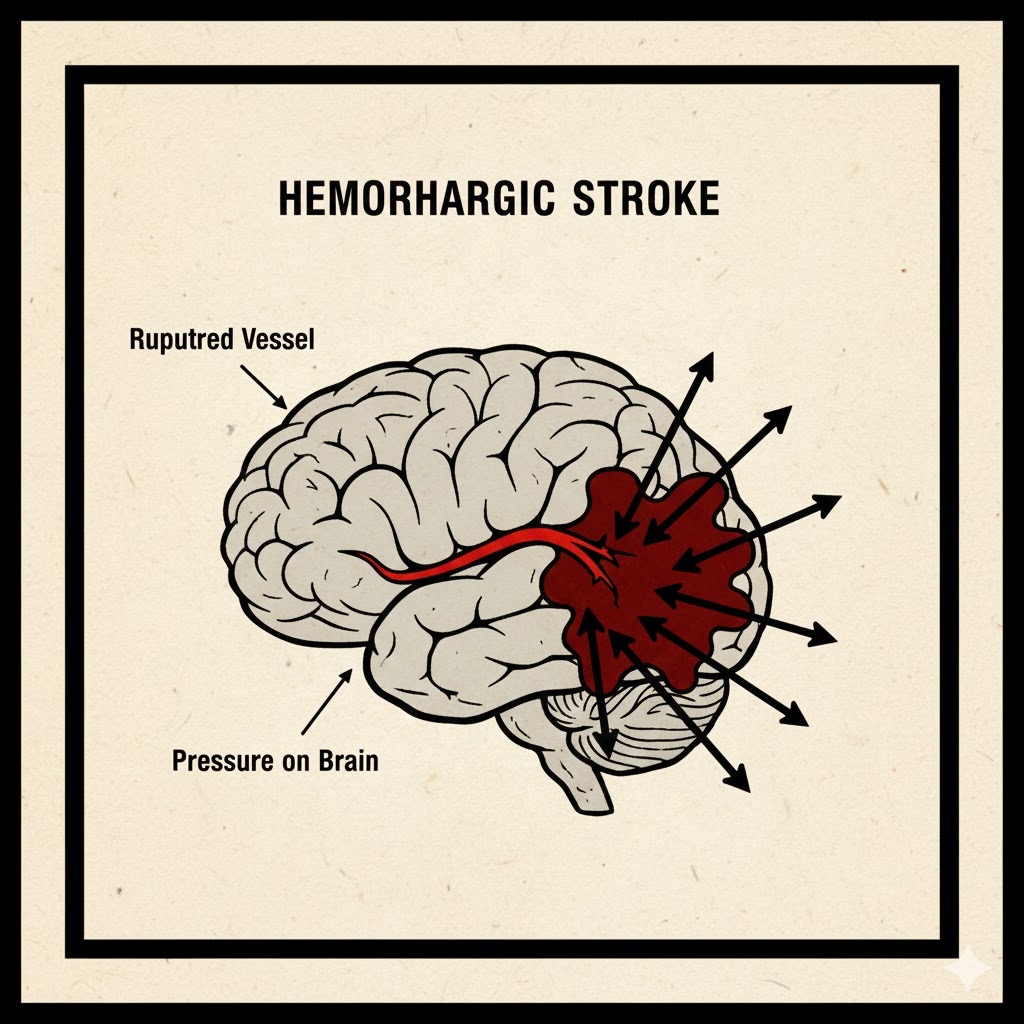
A hemorrhagic stroke is a life-threatening medical emergency that occurs when a blood vessel in the brain ruptures. While less common than ischemic strokes (caused by clots), hemorrhagic strokes are often more severe because the escaping blood not only deprives brain cells of oxygen but also creates dangerous pressure against the delicate brain tissue.
Types of Hemorrhagic Stroke
The classification depends on exactly where the bleeding occurs:
- Intracerebral Hemorrhage: The most common form, where bleeding occurs inside the brain tissue itself.
- Subarachnoid Hemorrhage: Bleeding occurs in the narrow space between the brain and the surrounding protective tissues. This is frequently caused by a burst aneurysm.
Key Causes
Several factors can cause a vessel to fail:
- High Blood Pressure (Hypertension): The leading cause. Persistent high pressure weakens artery walls until they crack or burst.
- Aneurysm: A weak, “ballooned” area in an artery wall that eventually pops.
- Arteriovenous Malformation (AVM): A rare, abnormal “tangle” of blood vessels that connects arteries and veins directly, bypassing capillaries. These tangles are prone to rupturing.
Symptoms and the F.A.S.T. Test
Symptoms appear suddenly. A hallmark sign of a hemorrhagic stroke is often described as the “worst headache of your life” with no known cause. Use the F.A.S.T. acronym:
- F (Face): Does one side of the face droop when smiling?
- A (Arms): Does one arm drift downward when both are raised?
- S (Speech): Is their speech slurred or strange?
- T (Time): If any signs are present, call 911 immediately.
Diagnosis and Treatment
Speed is the most critical factor in survival and recovery.
Diagnosis
Doctors use rapid CT scans or MRIs to locate the bleed and distinguish it from a clot-based stroke, as the treatments for the two are opposites.
Treatment
- Stop the Bleeding: Doctors may use medications to lower blood pressure or counteract blood thinners.
- Relieve Pressure: If the buildup of blood is creating too much pressure inside the skull, surgery may be required to drain the blood or repair the vessel.
- Surgical Repair: Procedures like clipping (placing a tiny metal clip on an aneurysm) or coiling (filling an aneurysm with wire to stop flow) may be used.
Prevention
The most effective way to prevent a hemorrhagic stroke is to control high blood pressure. Other heart-healthy habits include:
- Managing stress and cholesterol.
- Quitting smoking (which weakens artery walls).
- Avoiding illegal drugs (like cocaine), which can cause sudden, massive spikes in blood pressure.
About the Author


 Pharm'Up