India Achieves Global Benchmark: Union Health Minister Releases 10th Edition of Indian Pharmacopoeia 2026
 Pharm'Up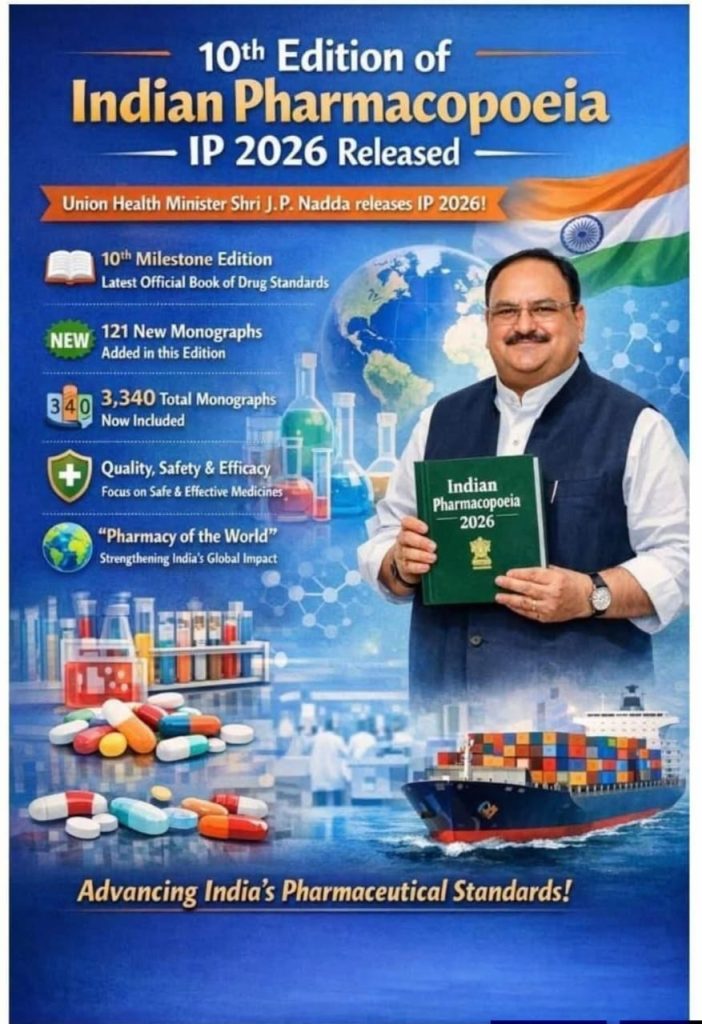
Union Minister for Health and Family Welfare, Shri J. P. Nadda, officially released the Indian Pharmacopoeia 2026 (IP 2026) today at the Dr. Ambedkar International Centre. This 10th edition marks a historic milestone in India’s journey from being a high-volume manufacturer to a global leader in pharmaceutical quality, safety, and regulatory excellence.
Key Highlights of IP 2026
The latest edition represents a significant expansion of drug standards, reflecting modern scientific advancements and India’s “Health Diplomacy” efforts.
- Total Monographs: Now stands at 3,340, providing a comprehensive framework for the majority of drugs marketed in India.
- New Additions:121 new monographs have been introduced, targeting critical health areas including:
- Anti-Tubercular medicines (supporting the National TB Elimination Programme).
- Anti-Diabetic and Anti-Cancer drugs.
- Iron Supplements (aligned with the Anaemia Mukt Bharat initiative).
- International Recognition: The IP is now officially recognized in 19 Global South countries (including Ghana, Nepal, Mauritius, Nauru, and Malawi), serving as a benchmark for their drug regulatory systems.
Revolutionary Inclusion: Blood Component Monographs
In a global first, IP 2026 has introduced 20 new blood component monographs for transfusion medicine. This move aligns with the Drugs and Cosmetics (Second Amendment) Rules, 2020, designating blood components legally as “drugs.”
Why This Matters:
- Safety: Ensures uniform quality standards to prevent transfusion-transmitted infections.
- Clinical Research: Provides a standardized baseline for research in thalassemia, hemophilia, and sickle cell anemia.
- Comprehensive Standards: Covers whole blood, red cell components, plasma components, and platelets, including specialized “irradiated” versions.
Global Leap in Pharmacovigilance
A standout achievement highlighted by Minister Nadda is India’s meteoric rise in the WHO Pharmacovigilance database (VigiBase).
| Period | Global Rank in WHO Contributions | Significance |
| 2009 – 2014 | 123rd | Limited infrastructure for reporting adverse drug reactions (ADRs). |
| 2025 | 8th | Robust, nationwide reporting through the Pharmacovigilance Programme of India (PvPI). |
This jump to the Top 10 globally underscores India’s commitment to patient safety and real-world monitoring of drug effects post-market.
Global Harmonization & “Health Diplomacy”
India is no longer operating in isolation. As a member of the Pharmacopoeial Discussion Group (PDG), the Indian Pharmacopoeia Commission (IPC) is actively harmonizing its standards with:
- United States Pharmacopoeia (USP)
- European Pharmacopoeia (Ph. Eur.)
- Japanese Pharmacopoeia (JP)
This alignment with International Council for Harmonisation (ICH) standards ensures that Indian-made medicines are “export-ready” and meet the highest global quality benchmarks.
The Vision: Atmanirbhar & Viksit Bharat
Shri Nadda credited the “visionary leadership” of Prime Minister Narendra Modi for strengthening healthcare systems. Union Health Secretary Punya Salila Srivastava added that a robust, science-based pharmacopoeia is essential for maintaining India’s role as the “Pharmacy of the World” while ensuring domestic public welfare.
About the Author





 Pharm'Up