Pharm'Up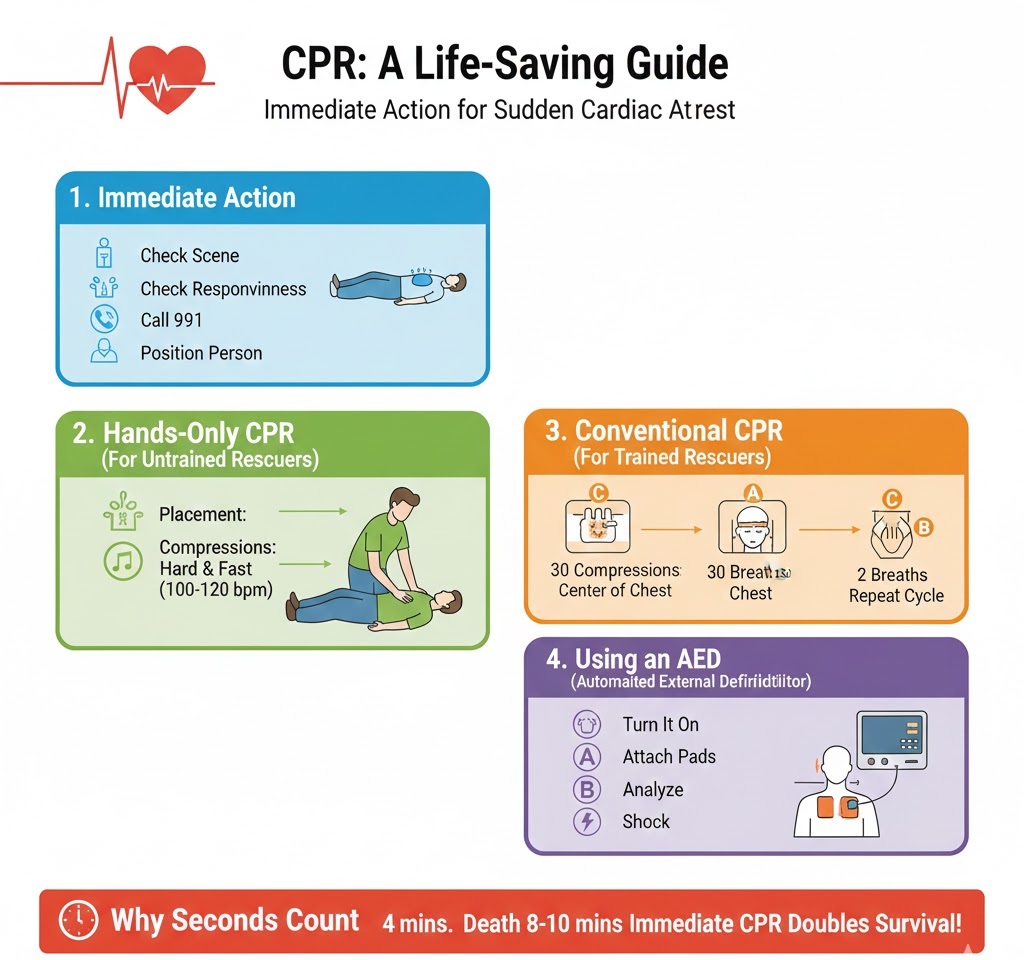
Cardiopulmonary Resuscitation (CPR) is a critical emergency procedure performed when a person’s heart stops beating (sudden cardiac arrest) or they stop breathing. In these moments, the heart can no longer pump blood to the brain and lungs. CPR serves as an external pump, manually circulating oxygenated blood to preserve brain function until professional medical help arrives.
1. Immediate Action Steps
When you encounter someone who is unresponsive and not breathing (or only gasping), follow this sequence immediately:
- Check the Scene: Ensure it is safe for you to help.
- Check Responsiveness: Tap their shoulder and shout.
- Call 911: If you are alone, use your cell phone on speaker. If others are present, designate a specific person to call and another to find an AED.
- Position the Person: Place them on their back on a firm, flat surface.
2. Hands-Only CPR (For Untrained Rescuers)
If you are not trained in conventional CPR, “Hands-Only” CPR is highly effective for teens and adults.
- Placement: Place the heel of one hand in the center of the chest (between the nipples) and the other hand on top, interlacing your fingers.
- Compressions: Push hard (at least 2 inches deep) and fast (100–120 beats per minute). A helpful tip is to push to the beat of the song “Stayin’ Alive.”
- Recoil: Allow the chest to return to its normal position between pushes; this allows blood to flow back into the heart.
3. Conventional CPR (For Trained Rescuers)
If you have been certified, follow the C-A-B acronym: Compressions, Airway, Breathing.
- Compressions: Perform 30 chest compressions.
- Airway: Tilt the head back slightly and lift the chin to open the airway.
- Breathing: Pinch the nose shut and give 2 rescue breaths, watching for the chest to rise.
- Ratio: Repeat the cycle of 30 compressions and 2 breaths.
4. Using an AED (Automated External Defibrillator)
An AED is a portable device that analyzes the heart’s rhythm and, if necessary, delivers an electric shock (defibrillation) to help the heart re-establish an effective rhythm.
- Turn it on: The device will provide voice prompts to guide you.
- Attach Pads: Apply the adhesive pads to the person’s bare chest as shown in the diagrams on the pads.
- Analyze: Ensure no one is touching the person while the device analyzes the rhythm.
- Shock: If the device advises a shock, ensure everyone is “clear” and press the shock button. Immediately resume CPR after the shock.
5. Why Seconds Count
Without blood flow, permanent brain damage begins in as little as 4 minutes, and death can occur within 8 to 10 minutes. Performing CPR immediately can double or triple a person’s chance of survival.
About the Author