Pharm'Up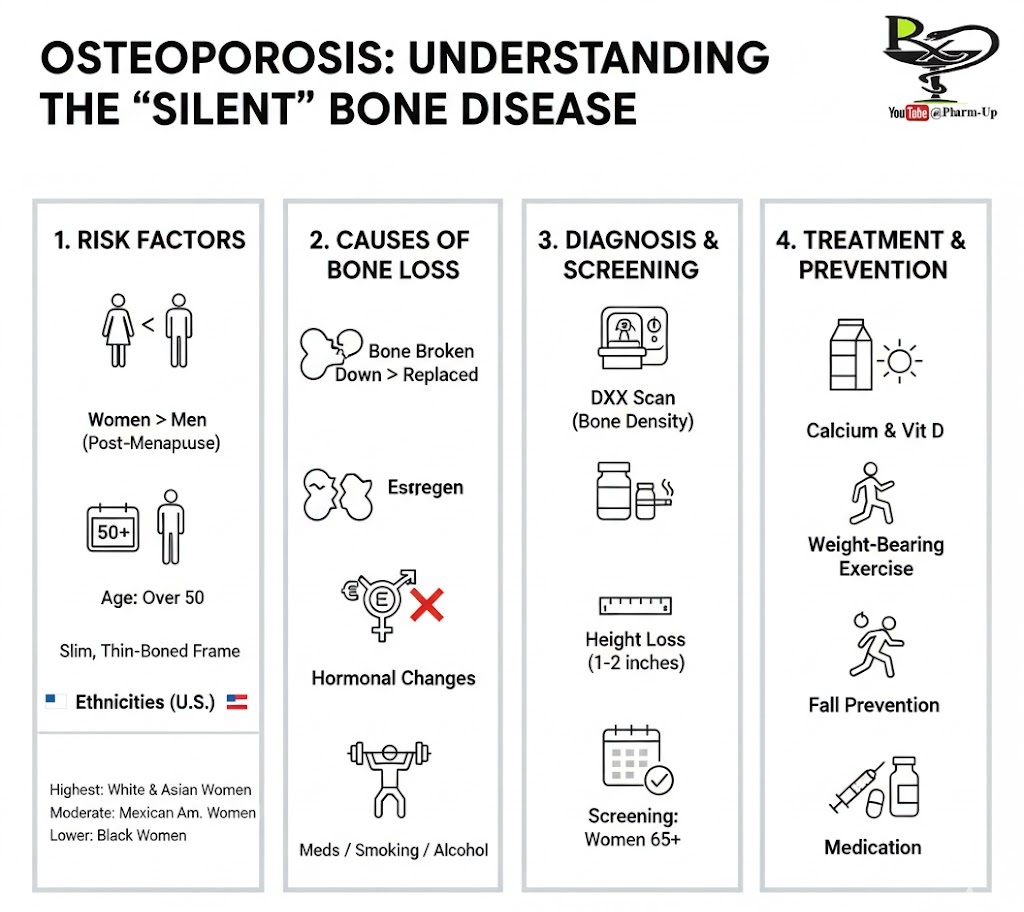
Osteoporosis is a systemic skeletal condition characterized by decreased bone mass and the deterioration of bone tissue. This leads to bone fragility and a significantly increased risk of fractures—particularly in the hip, spine, and wrist. It is often called a “silent disease” because bone loss typically occurs without symptoms until a sudden strain, bump, or fall causes a bone to break.
1. Risk Factors and Demographics
While anyone can develop osteoporosis, statistical data shows that certain groups are at a higher risk based on age, sex, and ethnicity.
By Sex and Age
- Women: Women are much more likely to develop the disease, especially after menopause, due to the drop in estrogen.
- Age 50+: Risk increases significantly after age 50; approximately 1 in 2 women and 1 in 4 men over 50 will break a bone due to osteoporosis.
By Race and Ethnicity (U.S. Data)
According to the CDC and the National Osteoporosis Foundation (NOF), prevalence varies across different groups:
| Group | Risk Level | Notable Statistics |
| :— | :— | :— |
| White & Asian Women | Highest Risk | Roughly 20% of non-Hispanic White and Asian women aged 50+ have osteoporosis. |
| Mexican American Women | Moderate-High | Prevalence is estimated at approximately 14-15%. |
| African American Women | Lower Risk | Prevalence is about 5%, though they are more likely to die following a hip fracture. |
| White Men | Higher Risk (Men) | About 4-5% of White men over age 50 have osteoporosis. |
| Black & Mexican American Men | Lower Risk (Men) | Prevalence is lower, estimated at around 2-3%. |
2. Causes of Bone Loss
The body constantly absorbs and replaces bone tissue. Osteoporosis occurs when the creation of new bone doesn’t keep up with the removal of old bone.
- Hormonal changes: Lowered sex hormones (estrogen/testosterone).
- Medications: Long-term use of corticosteroids, PPIs (for reflux), or anti-seizure drugs.
- Lifestyle: Physical inactivity, tobacco use, and excessive alcohol consumption.
3. Diagnosis and Screening
Since there are few warning signs, screening is the primary way to catch the disease early.
- DXA Scan: A specialized X-ray that measures bone mineral density (BMD).
- Height Monitoring: A loss of 1–2 inches in height can be a sign of “silent” vertebral fractures.
- Screening Guidelines: Recommended for all women age 65+ and younger postmenopausal women with specific risk factors.
4. Treatment and Prevention
The goal of treatment is to stabilize bone density and prevent life-altering falls.
- Nutrition: Ensuring high intake of calcium ($1,000–1,200\text{ mg/day}$) and Vitamin D.
- Medication: Bisphosphonates (to slow loss) or bone-building biologics.
- Exercise: Weight-bearing activities (walking, dancing) and resistance training.
- Safe Movement: Avoiding deep forward bends (like toe touches) or sharp spinal twists that could trigger a fracture in weak vertebrae.
About the Author