Pharm'Up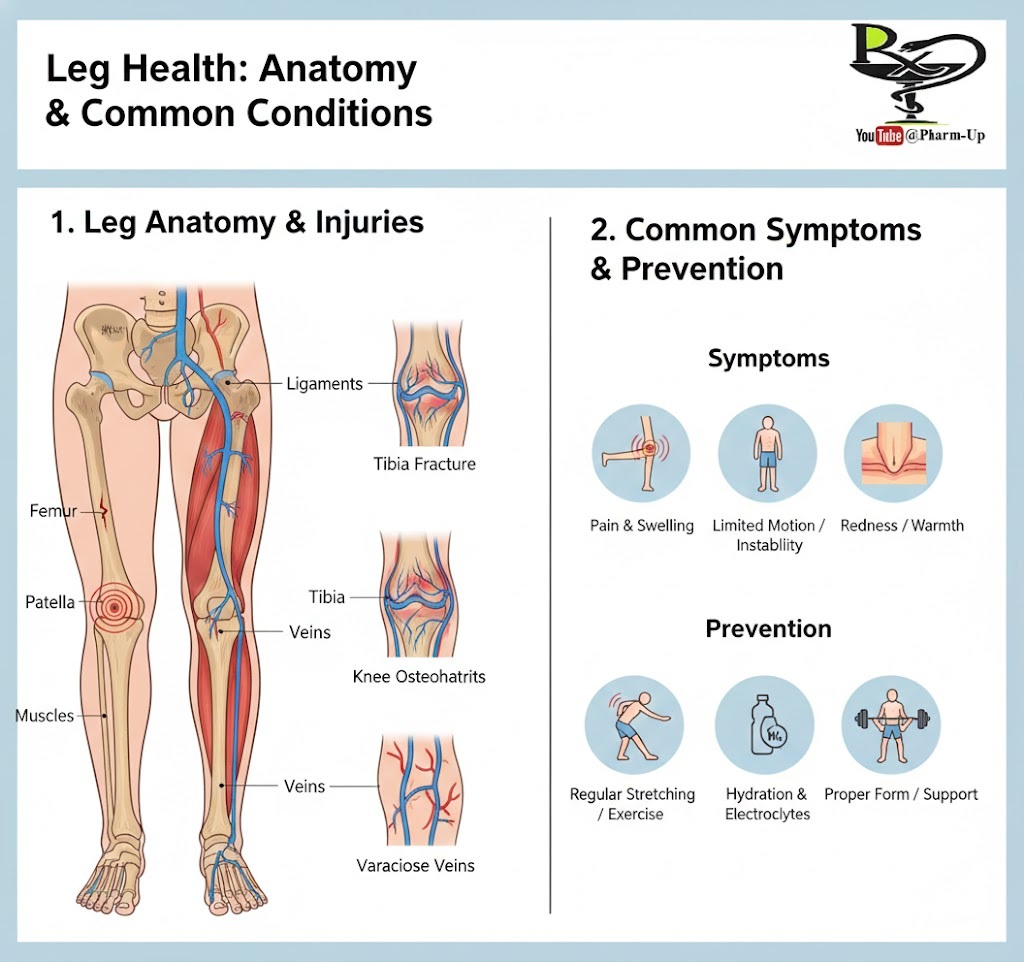
The legs are complex structures designed for weight-bearing and locomotion. They consist of a framework of bones held together by ligaments, powered by muscles and tendons, and supplied by a sophisticated network of blood vessels. Because of their constant use, they are highly susceptible to both acute injuries and chronic diseases.
1. Common Musculoskeletal Injuries
Leg injuries can occur suddenly during sports or accidents, or develop over time through repetitive strain.
- Fractures: A break in any of the leg bones (femur, tibia, or fibula). Stress fractures are small cracks that develop from repetitive force, common in runners.
- Sprains and Strains: * Sprain: Stretching or tearing of ligaments (connecting bone to bone), most common in the ankle.
- Strain: Stretching or tearing of muscles or tendons (connecting muscle to bone), often affecting the hamstrings or calves.
- Dislocations: Occur when bones in a joint (like the knee or hip) are forced out of alignment, often causing damage to surrounding nerves and ligaments.
2. Degenerative Joint Conditions
As we age, the protective tissues in our joints can wear down.
- Knee Osteoarthritis: The breakdown of cartilage in the knee joint. This leads to bone-on-bone friction, causing pain, stiffness, and a reduced range of motion.
- Hip Bursitis: Inflammation of the small, fluid-filled sacs (bursae) that cushion the hip joint, leading to localized pain during movement.
3. Vascular Disorders of the Leg
The veins in your legs have a difficult job: they must pump blood “uphill” back to the heart against gravity. When the valves in these veins fail, problems arise.
- Varicose Veins: Swollen, twisted veins that lie just under the surface of the skin. They occur when weak vein walls and valves allow blood to pool.
- Deep Vein Thrombosis (DVT): A serious condition where a blood clot forms in a deep vein, usually in the lower leg or thigh. If the clot breaks loose, it can travel to the lungs (pulmonary embolism), which is a medical emergency.
4. When to See a Professional
While minor muscle soreness often resolves with rest, you should seek medical attention if you experience:
- Inability to bear weight on the leg.
- Visible deformity or “out of place” appearance of a joint.
- Sudden swelling, warmth, or redness in the calf (potential sign of DVT).
- Persistent numbness or tingling.
About the Author