Pharm'Up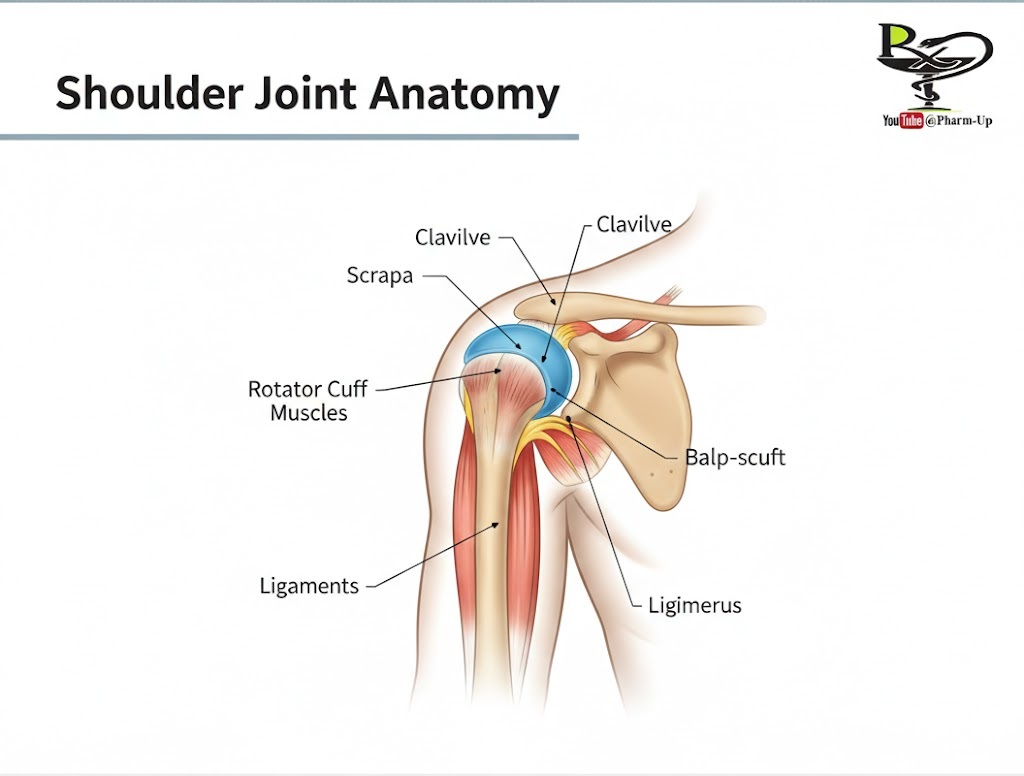
The shoulder is a remarkable feat of human anatomy, designed for an extraordinary range of motion. However, this flexibility comes at a price: instability. Because the shoulder joint functions much like a golf ball sitting on a tee, it relies heavily on soft tissues to stay in place, making it one of the most frequently injured areas of the body.
1. The Anatomy of the “Ball and Socket”
Three primary bones meet to form the shoulder joint:
- Humerus: The upper arm bone, featuring a “ball” at the top.
- Scapula: The shoulder blade, which contains the shallow socket (glenoid).
- Clavicle: The collarbone, which acts as a structural bridge between the torso and the arm.
To keep the humerus centered in its shallow socket, the body uses the Rotator Cuff—a group of four muscles and their tendons that wrap around the head of the humerus like a sleeve.
2. Common Shoulder Injuries
Because the shoulder is so mobile, it is susceptible to several types of mechanical and inflammatory issues:
- Dislocations and Separations: A dislocation occurs when the humerus pops out of the socket. A separation involves the ligaments connecting the collarbone and shoulder blade.
- Rotator Cuff Tears: Often caused by repetitive overhead motions or sudden trauma, these tears lead to significant weakness and pain when lifting the arm.
- Frozen Shoulder (Adhesive Capsulitis): A condition characterized by stiffness and pain that makes it nearly impossible to move the joint.
- Bursitis and Tendinitis: Inflammation of the fluid-filled sacs (bursae) or the tendons, usually due to overuse.
3. Diagnosis and Treatment
If you experience persistent shoulder pain, a healthcare provider will typically use a combination of physical maneuvers and imaging (such as X-rays or MRI) to identify the source.
Initial Care: The R.I.C.E. Method
For minor strains and sprains, the standard first-aid approach is:
- Rest: Avoid heavy lifting or overhead reaching.
- Ice: Apply cold packs for 15–20 minutes to reduce inflammation.
- Compression: Using an elastic wrap to support the joint.
- Elevation: Keeping the shoulder supported and slightly raised.
Advanced Treatment
If R.I.C.E. and over-the-counter anti-inflammatories are insufficient, further options include:
- Physical Therapy: Strengthening the muscles around the joint to improve stability.
- Corticosteroid Injections: To provide temporary relief from intense inflammation.
- Surgery: Necessary for complete tendon tears or chronic instability that physical therapy cannot fix.
About the Author