Pharm'Up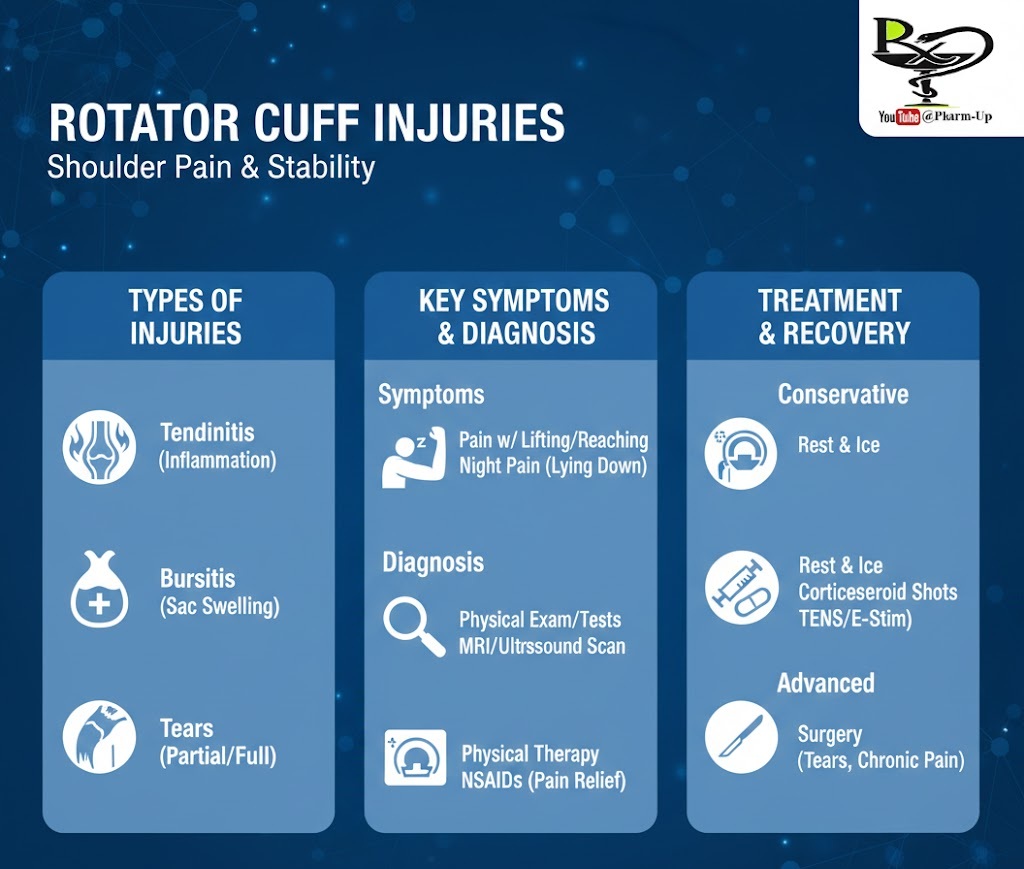
The rotator cuff is a vital group of four muscles and their tendons that act as the primary stabilizers of the shoulder joint. It functions like a sleeve, holding the “ball” of your upper arm bone (humerus) securely in the “socket” of your shoulder blade (scapula).
Common Types of Rotator Cuff Injuries
Injuries typically fall into three categories, ranging from inflammation to physical separation of the tissue:
- Tendinitis: The tendons become inflamed or irritated, often due to being “pinched” during overhead movements (impingement).
- Bursitis: Inflammation of the bursa, the fluid-filled sac that acts as a cushion. Excessive rubbing between bone and muscle causes the sac to swell.
- Tears: A physical rip in the tendon. These can be partial or complete (full-thickness). They can happen slowly due to age or suddenly due to trauma like a fall.
Who is at Risk?
- Age 40+: Natural wear and tear makes the tendons more brittle over time.
- Overhead Athletes: Swimmers, tennis players, and baseball pitchers.
- Manual Trades: Carpenters, painters, and construction workers who frequently reach above their heads.
Symptoms & Diagnosis
Warning Signs
- Pain when lifting or lowering the arm (especially to the side).
- Difficulty reaching behind the back (e.g., tucking in a shirt).
- Night Pain: Significant discomfort when lying on the affected shoulder.
- Weakness in the arm and clicking/popping sounds during movement.
Diagnosis
- Strength Testing: Resistance tests to see which specific tendon is affected.
- Range of Motion: Checking for “painful arcs” during arm movement.
- Imaging: Ultrasound or MRI are the gold standards for seeing soft tissue tears that X-rays cannot detect.
Treatment Options
| Conservative Care | Advanced Medical Care |
| Rest & Ice: To reduce acute inflammation. | Corticosteroid Injections: To reduce severe swelling. |
| Physical Therapy: Crucial for strengthening supporting muscles. | TENS Therapy: Electrical stimulation for pain management. |
| NSAIDs: Ibuprofen or Aspirin for pain relief. | Surgery: Needed for large tears or if pain persists for 6–12 months. |
About the Author