Pharm'Up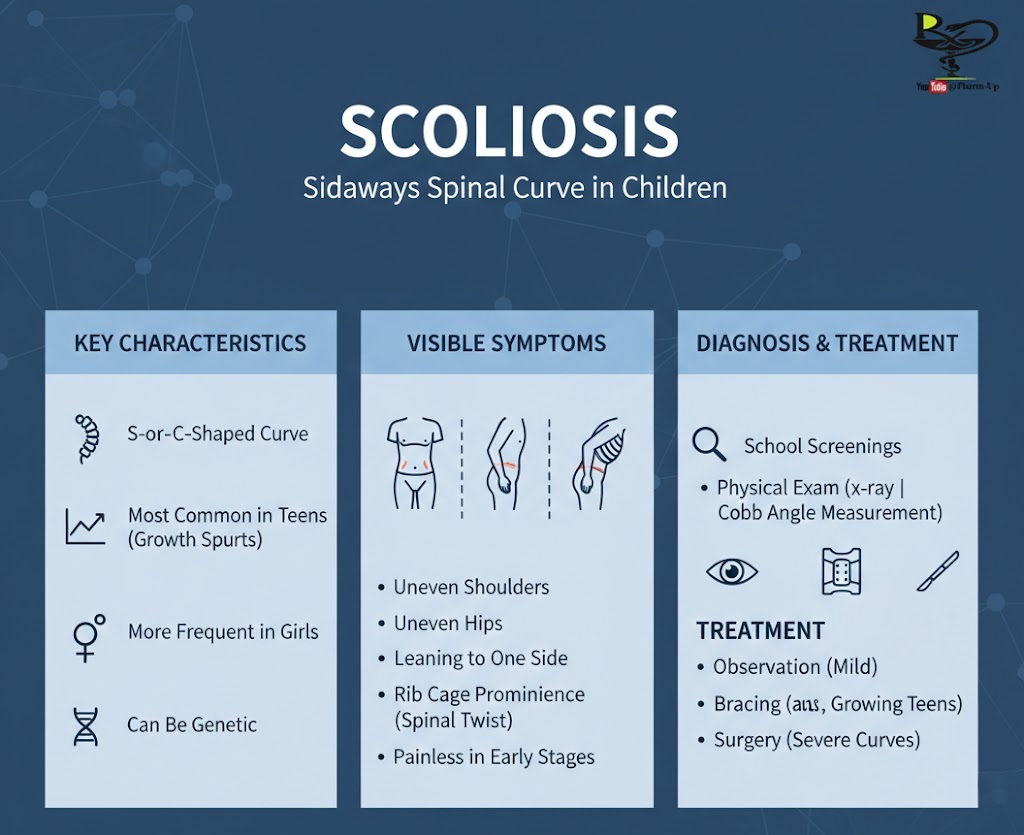
Scoliosis is a medical condition characterized by an abnormal sideways curvature of the spine. While a healthy spine has natural curves when viewed from the side, a spine with scoliosis appears as an “S” or “C” shape when viewed from the back.
Key Characteristics & Risks
- Growth Spurt Onset: It most commonly develops during the rapid growth period just before puberty, typically in late childhood or early teens.
- Gender Factors: While both boys and girls develop mild scoliosis at similar rates, girls have a significantly higher risk of the curve worsening and requiring treatment.
- Genetics: The condition often runs in families, suggesting a hereditary component.
Visible Symptoms
Scoliosis can be subtle, but key physical “red flags” include:
- Uneven Shoulders: One shoulder blade may appear more prominent than the other.
- Uneven Waist: One hip may sit higher or appear more prominent.
- Leaning: The entire body may tilt to one side.
- Rib Hump: When bending forward, one side of the rib cage may protrude more than the other (detected via the Adam’s Forward Bend Test).
Diagnosis and Management
Diagnosis
- Screening: Often detected during routine school screenings or pediatric checkups.
- Physical Exam: Checking the symmetry of the back and hips.
- Imaging: X-rays are the primary tool to measure the Cobb Angle, which determines the severity of the curve in degrees.
Treatment Pathways
Treatment is highly individualized based on the patient’s age and the degree of the curve:
- Observation: For mild curves (usually under 20 degrees), doctors “watch and wait” with checkups every 6 months.
- Bracing: If the curve is moderate and the child is still growing, a brace can prevent the curve from progressing further.
- Surgery: For severe curves (typically over 40–50 degrees), spinal fusion surgery may be necessary to straighten and stabilize the spine.
About the Author