Mrs. Deepika Gupta
Introduction to Carbohydrates
Carbohydrates are organic compounds with the general formula Cn(H2O)n. They are composed of carbon, hydrogen, and oxygen. Carbohydrates are polyhydroxy aldehydes or ketones, or compounds derived from hydrolysis. They serve as a major source of chemical energy for living organisms. Common examples include sugars and starch. Starch and cellulose are two prevalent carbohydrates.
Classification of Carbohydrates
Carbohydrates can be classified based on complexity, reactivity, and functional groups.
Classification by Complexity
- Monosaccharides (Simple Sugars)
Carbohydrates that cannot be hydrolyzed to simpler compounds.
Single-unit carbohydrates (one sugar molecule).
Examples: Glucose, fructose, galactose. - Oligosaccharides
Consist of 2-10 units of monosaccharides.
Disaccharides: Composed of two monosaccharide units.
Example: Sucrose (glucose + fructose).
Trisaccharide: Composed of three monosaccharide units.
Example: Raffinose (glucose + fructose + galactose). - Polysaccharides
Formed by the polymerization of more than 10 monosaccharide units.
Examples: Starch, cellulose.
Classification by Reactivity
1. Reducing Sugars: Act as reducing agents and can reduce Fehling’s and Tollens reagents.
2. Non-Reducing Sugars: Do not reduce Fehling’s and Tollens reagents.
Classification by Functional Groups
1. Aldose: Sugars with an aldehyde functional group.
Example: D-glucose.
2. Ketose: Sugars with a ketone functional group.
Example: D-fructose.
Monosaccharides
Monosaccharides, derived from the Greek words “mono” (single) and “saccharide” (sugar), cannot be hydrolyzed further to yield simpler sugars. They are simple sugars with a sweet flavor, soluble in water, and have a crystalline appearance. They typically contain 3-10 carbon atoms, two or more hydroxyl (OH) groups, and one aldehyde (CHO) or ketone (CO) group. The general formula is CnH2nOn.
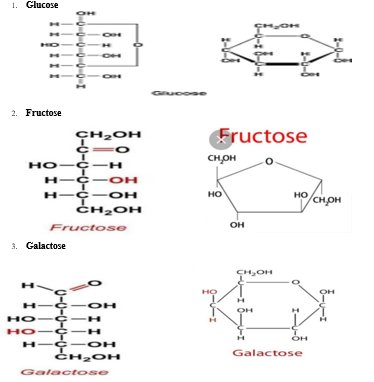
Structures of Common Monosaccharides
- Glucose 2. Fructose 3. Galactose
Disaccharides
Disaccharides are carbohydrates made up of two monosaccharide units. They can be either reducing sugars (e.g., lactose) or non-reducing sugars (e.g., sucrose).
Structures of Common Disaccharides
- Maltose
- Lactose
- Sucrose

Polysaccharides
Polysaccharides are composed of long chains of monosaccharide units. They are a major class of biomolecules, serving as an important source of energy in animals and forming structural components in plant cells. Polysaccharides typically do not have a sweet flavor, many are water-insoluble, and they are hydrophobic with high molecular weight. They are composed of hydrogen, carbon, and oxygen.
Classification of Polysaccharides
- Homopolysaccharides
Monomeric units are arranged in long chains, either unbranched or branched.
Examples: Starch, glycogen, cellulose. - Heteropolysaccharides
Polymers containing different monosaccharides.
Example: Heparin.
Chemical Nature of Starch
1. Glucose: is stored in plants in the form of starch, composed of amylose and amylopectin.
2. Amylose: Consists of 250-300 glucose units joined by α-1,4 glycosidic bonds, unbranched, and coiled.
3. Amylopectin: A glucose polymer with α-1,4 glycosidic linkages and side chains linked by α-1,6 glycosidic bonds.
Chemical Nature of Glycogen
1. Glucose is stored in animals as glycogen, found mostly in the liver and muscles, and often referred to as animal starch.
2. Glycogen is highly branched, with 8-10 glucose units per branch, joined by α-1,4 glycosidic links and branches connected by α-1,6 glycosidic bonds.
3. The structure of glycogen is similar to amylopectin but more highly branched.
Qualitative Tests for Carbohydrates
Fehling’s Test
Mix 1-2 ml each of Fehling’s solution A and B with a few drops of the test solution and boil. A yellowish-red color indicates the presence of reducing sugars.
Tollen’s Test
Add 2-3 ml of Tollen’s reagent to 2-3 ml of an aqueous carbohydrate solution and boil in a water bath for 10 minutes. A shining silver mirror indicates the presence of reducing carbohydrates.
Biological Role of Carbohydrates
1. Source of energy for living organisms.
2. Serve as dietary fibers like cellulose.
3. Used as flavoring and sweetening agents.
4. Stored in the body as glycogen in the liver and muscles, converting to glucose to meet energy needs.
5. Important components of brain cells.
6. Components of DNA and RNA (deoxyribose and ribose sugars).
7. Act as anticoagulants in the form of heparin.
8. Major components of cartilage, tendons, and bones.
9. Used in clearance tests as inulin.
10. Employed in treating heart diseases as glycosides.
About the Author


 Pharm'Up

 Pharm'Up