Mazdutide, a Dual GLP-1/GCG Agonist, Demonstrates Superiority Over Semaglutide in Glycemic Control and Weight Loss for Type 2 Diabetes Patients
 Pharm'Up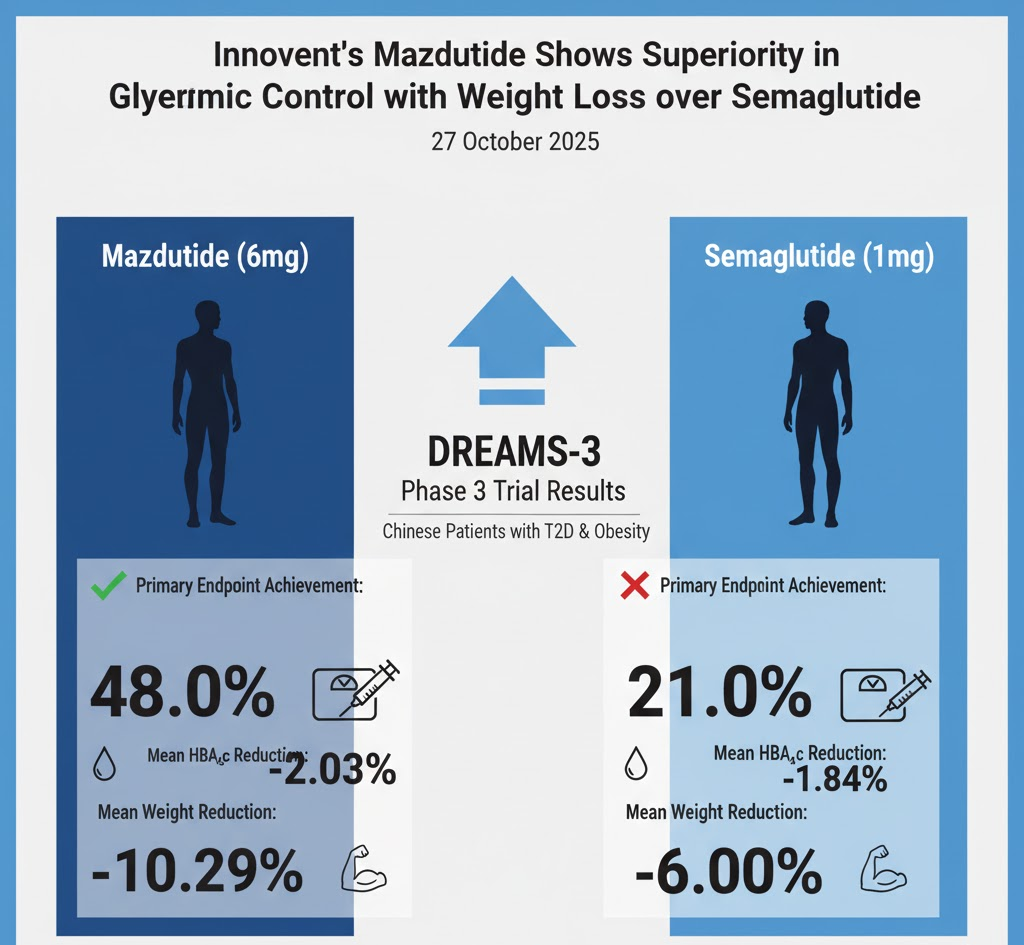
Innovent Biologics announced that its fourth Phase 3 clinical trial, DREAMS-3, evaluating the novel drug mazdutide in Chinese patients with Type 2 Diabetes (T2D) and obesity, successfully met its primary endpoint. Mazdutide is a first-in-class dual glucagon-like peptide-1 (GLP-1) and glucagon (GCG) receptor agonist.
The trial demonstrated that mazdutide was superior to semaglutide (a leading GLP-1 receptor agonist) in achieving the combined therapeutic goal of significant glucose lowering and substantial weight reduction.
| Outcome Measure | Mazdutide Group | Semaglutide Group |
| Primary Endpoint Achievement (Proportion achieving HbA1c < 7.0% AND $\geq 10\%$ weight reduction at Week 32) | 48.0% | 21.0% |
| Mean Change in HbA1c from Baseline (at Week 32) | $-2.03\%$ | $-1.84\%$ |
| Mean Weight Reduction from Baseline (at Week 32) | $10.29\%$ | $6.00\%$ |
Drug Mechanism and Clinical Significance
Mazdutide is the world’s first and only approved GCG/GLP-1 dual receptor agonist indicated for both weight management and T2D treatment, developed under a license agreement between Innovent Biologics and Eli Lilly and Company for China.
- Mechanism: As a mammalian oxyntomodulin (OXM) analogue, mazdutide leverages two pathways:
- GLP-1 Receptor Activation: Promotes insulin secretion, lowers blood glucose, and reduces appetite leading to weight loss.
- GCG Receptor Activation: May increase energy expenditure and improve hepatic fat metabolism.
- Safety Profile: The overall safety profile was consistent with prior studies, with no new signals. Gastrointestinal symptoms were the most common adverse events, generally mild to moderate.
- Multiple Metabolic Benefits: Beyond glucose and weight management, clinical studies show mazdutide can also reduce: waist circumference, blood lipids, blood pressure, serum uric acid, liver enzymes, and liver fat content, while improving insulin sensitivity.
Professor Linong Ji, Principal Investigator of DREAMS-3, highlighted that the superior efficacy of mazdutide offers a vital combined treatment strategy to address the growing dual challenge of diabetes and obesity in China, making it a new-generation GLP-1-based therapy.
DREAMS-3 Trial Design
The study was a multi-center, randomized, open-label Phase 3 trial.
- Participants: 349 Chinese adults with early-stage T2D and obesity, who had inadequate control with lifestyle intervention (with or without metformin).
- Treatment: Participants were randomized 1:1 to receive either mazdutide 6 mg or semaglutide 1 mg for 32 weeks.
- Primary Endpoint: The proportion of participants achieving a composite endpoint of HbA1c < 7.0% and $\geq 10\%$ body weight reduction at week 32.
About the Author





 Pharm'Up