Landmark VESALIUS-CV Trial: Repatha Becomes First PCSK9 Inhibitor to Slash Primary Heart Event Risk by 25%
 Pharm'Up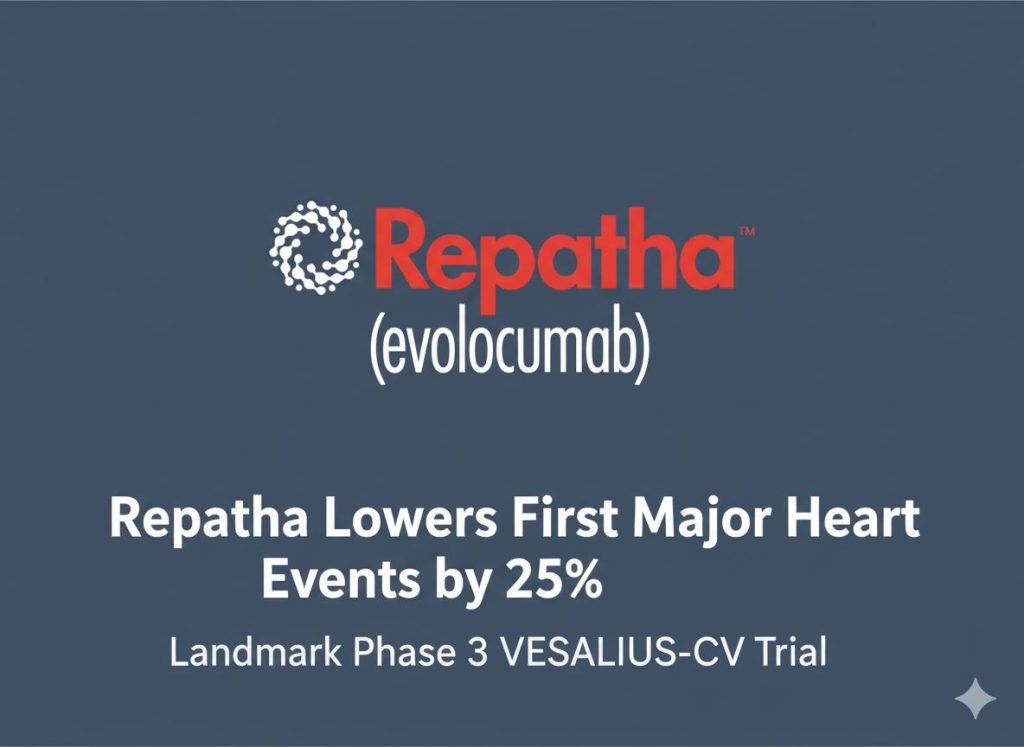
Amgen has announced detailed, pivotal results from its Phase 3 VESALIUS-CV clinical trial, proving that Repatha® (evolocumab) significantly reduces the risk of major adverse cardiovascular events (MACE) in high-risk adults who have not yet had a heart attack or stroke (primary prevention).
The findings establish Repatha as the first and only PCSK9 inhibitor to demonstrate a significant reduction of cardiovascular events across both high-risk primary and secondary prevention populations. The results were presented at the 2025 American Heart Association Scientific Sessions and published in the New England Journal of Medicine.
Key Efficacy Results (Primary Prevention)
The landmark study involved over 12,000 patients with atherosclerosis or diabetes but no prior MACE. When Repatha was added to statins or other LDL-C lowering treatments, the results showed:
- 25% Relative Risk Reduction in the risk of the primary composite endpoint (3-P MACE): coronary heart disease (CHD) death, heart attack, or ischemic stroke.
- 36% Reduction specifically in the risk of heart attack.
- 19% Reduction in the broader composite endpoint (4-P MACE), which also included any ischemia-driven arterial revascularization.
The median LDL-C level achieved in the Repatha arm was a highly intensive 45 mg/dL, compared to $109$ mg/dL in the placebo arm.
Implications for High-Risk Patients
The study provides strong evidence supporting aggressive LDL-C lowering in patients at high risk, particularly those with diabetes (nearly 60% of trial participants).
- Dr. Jay Bradner, Amgen’s EVP of Research and Development, emphasized the findings: “Repatha has once again demonstrated its ability to protect patients from the cardiovascular events they fear most, like heart attack or stroke, even before one occurs.”
- The results build on the success of the prior FOURIER trial, which proved Repatha’s benefit in patients with a prior MACE (secondary prevention). The combined data supports targeting median LDL-C levels in the range of approximately $30$ to $45$ mg/dL across a broad spectrum of high-risk patients.
Secondary Endpoints and Safety
Repatha also significantly reduced the risk of most secondary endpoints. Furthermore, there were numerical trends for reduced mortality rates, including:
- Cardiovascular death ($21\%$ relative risk reduction).
- All-cause death ($20\%$ relative risk reduction).
- Ischemic stroke ($21\%$ relative risk reduction).
Safety and Tolerability: No new safety signals were identified, and the tolerability profile was consistent with Repatha’s current prescribing information.
About the Author