Pharm'Up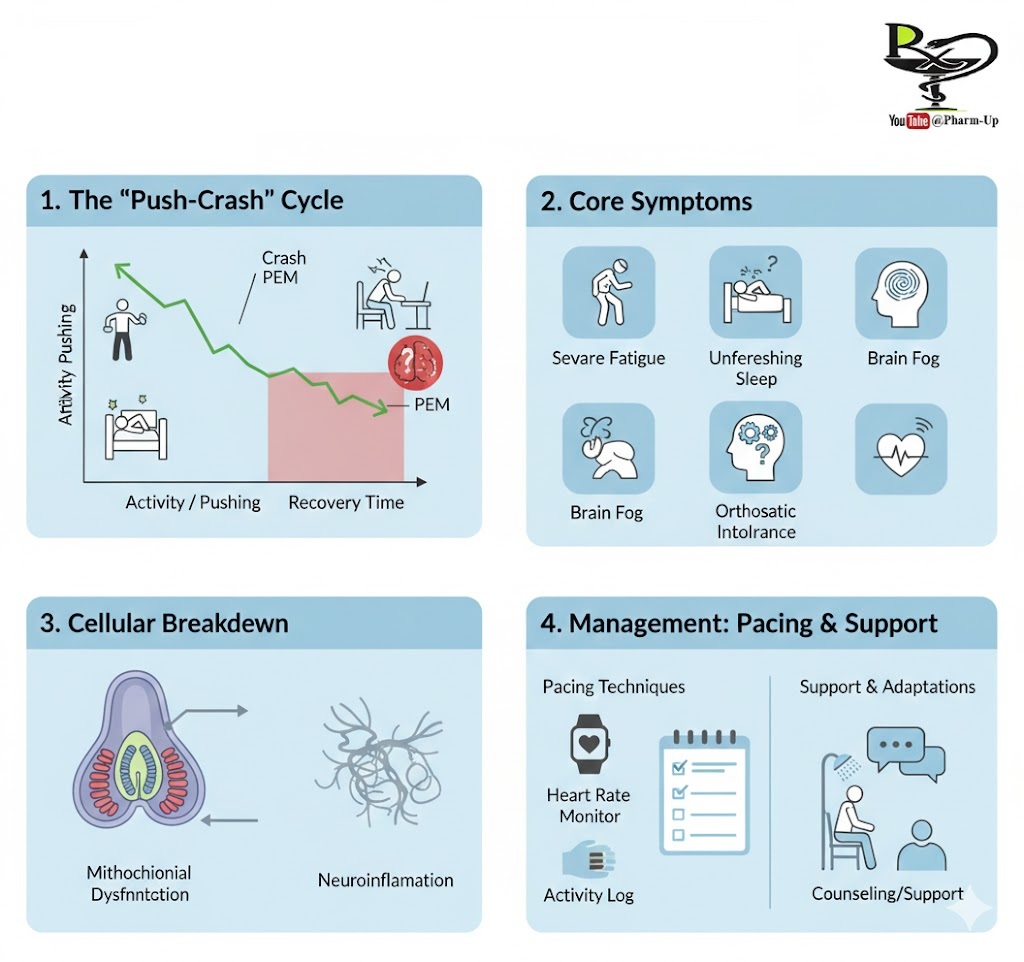
Myalgic Encephalomyelitis/Chronic Fatigue Syndrome (ME/CFS) is a complex, multi-system chronic disease characterized by profound fatigue, cognitive dysfunction, and a hallmark symptom called Post-Exertional Malaise (PEM). It is not merely “being tired”; it is a systemic breakdown where the body’s ability to produce and manage energy is severely impaired.
1. The Hallmark Symptom: Post-Exertional Malaise (PEM)
PEM is the defining characteristic of ME/CFS. It is an intense worsening of symptoms following even minor physical, mental, or emotional effort.
- The “Crash”: Unlike normal tiredness, PEM may not appear until 24–48 hours after the activity.
- The “Push-Crash” Cycle: Patients often feel slightly better and try to catch up on tasks (“pushing”), which triggers a massive “crash” that can last days, weeks, or even cause a permanent baseline shift.
2. Core Diagnostic Criteria
Because there is no “blood test” for ME/CFS, doctors use a clinical “cluster” of symptoms that must persist for at least 6 months:
- Reduction in Activity + Severe Fatigue: Fatigue that is new, not the result of ongoing excessive exertion, and not substantially relieved by rest.
- Post-Exertional Malaise (PEM): Symptoms flare up after activity.
- Unrefreshing Sleep: Waking up feeling just as tired as before going to bed.
- Cognitive Impairment (“Brain Fog”): Problems with word-finding, processing information, and short-term memory.
- Orthostatic Intolerance: Dizziness or a racing heart (POTS-like symptoms) when standing or sitting upright.
3. Potential Biological Causes
Research suggests ME/CFS involves a “perfect storm” of triggers:
- Mitochondrial Dysfunction: Evidence suggests the “power plants” of cells (mitochondria) fail to convert nutrients into energy efficiently.
- Dysautonomia: An imbalance in the Autonomic Nervous System, which controls “automatic” functions like heart rate and blood pressure.
- Neuroinflammation: Inflammation within the brain and spinal cord, contributing to “brain fog” and pain.
- Viral Triggers: Many cases begin after a viral infection (like Epstein-Barr or COVID-19), leading researchers to look at persistent immune activation.
4. Managing the Condition: “Pacing”
Since there is no cure, the primary management tool is Pacing. This is a strategy to stay within your “energy envelope” to avoid PEM.
- Heart Rate Monitoring: Some patients use wearable tech to ensure their heart rate stays below a certain threshold to prevent overexertion.
- Activity Logging: Keeping track of mental and physical tasks to identify triggers.
- Aggressive Rest: Resting before you feel tired to preserve energy.
5. Support and Resources
Living with ME/CFS is often isolating because it is an “invisible illness.” Support involves:
- Validation: Acknowledging the severity of the illness is the first step in mental health support.
- Ergonomic Adjustments: Using shower chairs, motorized carts, or blue-light filters to reduce sensory and physical load.
- Specialists: Seeking out neurologists or immunologists familiar with the updated CDC and NAM guidelines.
About the Author