Skip to content
  • YouTube
  • Facebook
  • LinkedIn
Pharm'Up

Pharm'Up

An E-platform for Learners

Primary Menu
  • Home
  • News
  • Industries
  • Disease
  • Drugs
  • Events
  • Jobs
  • Trainings
  • Conferences
  • Syllabus
  • Previous Papers
  • Notes
  • Colleges
Live
  • Home
  • 2026
  • April
  • 15
  • Understanding Gallbladder Cancer: Risks, Symptoms, and Treatment
  • Disease

Understanding Gallbladder Cancer: Risks, Symptoms, and Treatment

Pharm'Up 2 min read

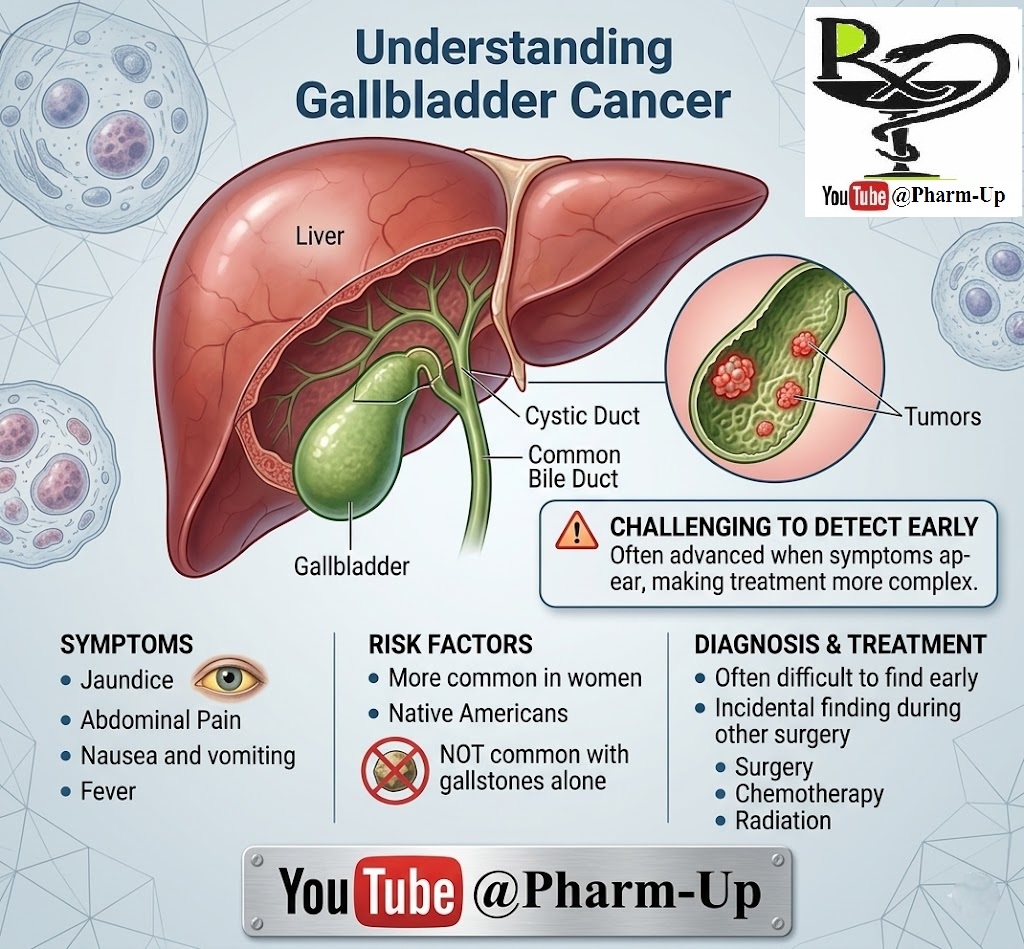
The gallbladder is a small, pear-shaped organ located just beneath the liver. Its primary role is to store bile, a digestive fluid produced by the liver that helps break down fats. When you eat, the gallbladder releases this bile into the small intestine through the common bile duct.

While the gallbladder plays a vital role in digestion, it can occasionally be the site of rare but serious conditions, such as gallbladder cancer.


Symptoms and Detection

Gallbladder cancer is notoriously difficult to diagnose in its early stages because it often doesn’t cause symptoms until it has progressed. In some cases, it is discovered incidentally during surgery for other issues, such as gallbladder removal.

Common symptoms include:

  • Jaundice: Yellowing of the skin and the whites of the eyes.
  • Abdominal Pain: Specifically in the area above the stomach.
  • Digestive Distress: Nausea, vomiting, and persistent bloating.
  • Physical Changes: Fever or the presence of lumps in the abdomen.

Risk Factors

Though rare, certain demographics show a higher prevalence of this condition:

  • Gender: It is more frequently diagnosed in women.
  • Ethnicity: Native Americans have a higher statistical risk.
  • Note on Gallstones: Interestingly, while gallstones are common, they rarely lead to gallbladder cancer.

Treatment Options

Because this cancer is often detected at a later stage, treatment can be challenging. Medical professionals typically use a combination of the following:

  1. Surgery: To remove the gallbladder and surrounding affected tissue.
  2. Chemotherapy: Using drugs to kill cancer cells.
  3. Radiation Therapy: Using high-energy beams to target and destroy tumors.

About the Author

Pharm'Up

Author

An E-platform for Pharma Learners

View All Posts

Post navigation

Previous: Understanding Diverticular Conditions: From Pouches to Inflammation
Next: Understanding Stomach Cancer: Risk Factors, Symptoms, and Diagnosis

Related Stories

Pharmup 21
2 min read
  • Disease

Understanding Small Intestine Cancer: Risks, Symptoms, and Treatment

Pharm'Up
Pharmup 20
2 min read
  • Disease

Infant Reflux (GER) and GERD: Spitting Up and Growth

Pharm'Up
Pharmup 19
2 min read
  • Disease

Understanding Reflux (GER) and GERD in Children

Pharm'Up

Recent Posts

  • Understanding Small Intestine Cancer: Risks, Symptoms, and Treatment
  • Infant Reflux (GER) and GERD: Spitting Up and Growth
  • Understanding Reflux (GER) and GERD in Children
  • Gastroenteritis: Understanding the “Stomach Bug” and Food Poisoning
  • Stomach Health: Understanding Function and Common Disorders

Recent Comments

No comments to show.

Archives

  • April 2026
  • March 2026
  • February 2026
  • January 2026
  • December 2025
  • November 2025
  • October 2025
  • September 2025
  • August 2025
  • July 2025

Categories

  • Colleges
  • Conferences/ Workshops
  • Disease
  • Drugs
  • Events
  • Industries
  • Notes
  • Pharma Jobs
  • Pharma News
  • Previous Papers
  • Syllabus
  • Trainings/ Courses
  • Uncategorized

Read These Too

Pharmup 21
2 min read
  • Disease

Understanding Small Intestine Cancer: Risks, Symptoms, and Treatment

Pharm'Up
Pharmup 20
2 min read
  • Disease

Infant Reflux (GER) and GERD: Spitting Up and Growth

Pharm'Up
Pharmup 19
2 min read
  • Disease

Understanding Reflux (GER) and GERD in Children

Pharm'Up
Pharmup 18
2 min read
  • Disease

Gastroenteritis: Understanding the “Stomach Bug” and Food Poisoning

Pharm'Up
  • YouTube
  • Facebook
  • LinkedIn
Copyright ©Pharm'UP All rights reserved by Eduversity India | MoreNews by AF themes.