Pharm'Up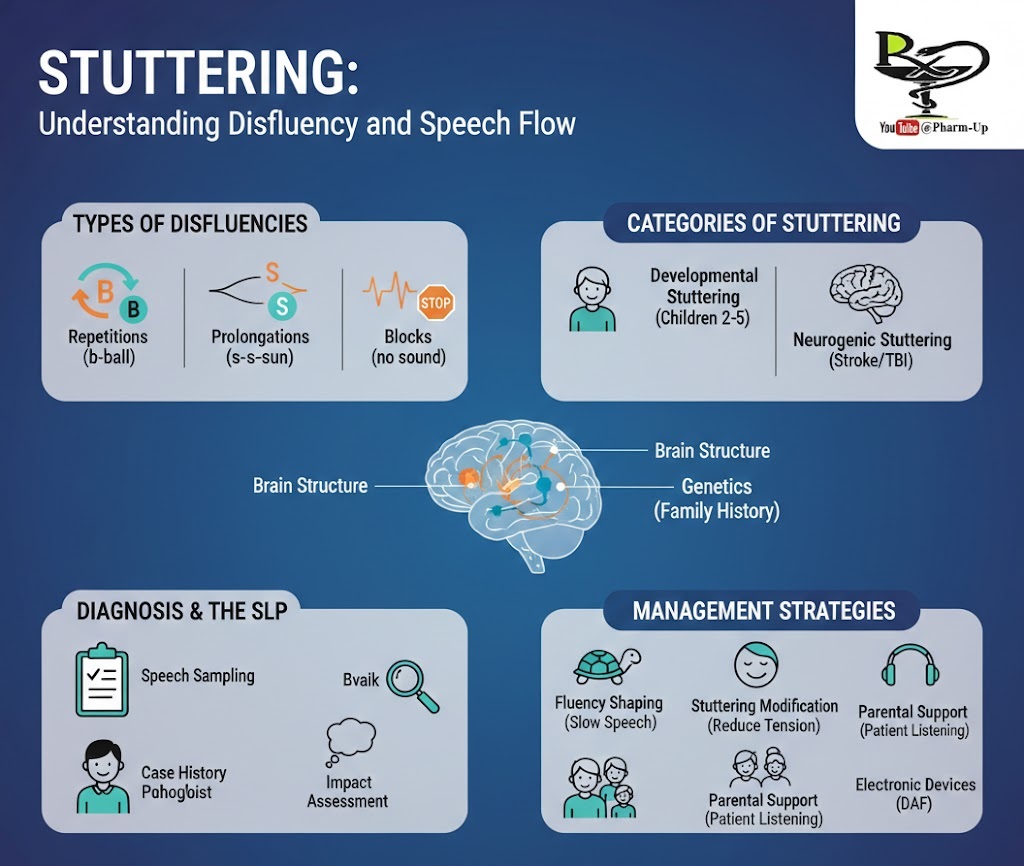
Stuttering is a speech disorder characterized by disruptions in the “rhythm” or flow of talk, known as disfluencies. It is not a reflection of a person’s intelligence; rather, it is a physical struggle to produce the motor movements required for speech.
Types of Disfluencies
Stuttering manifests in three primary ways:
- Repetitions: Repeating sounds, syllables, or words (e.g., “b-b-b-ball”).
- Prolongations: Stretching out a sound for an extended period (e.g., “ssssssun”).
- Blocks: A sudden stop where no sound comes out at all, often accompanied by physical tension in the throat or jaw.
The Two Categories of Stuttering
Understanding the origin of the stutter is key to determining the correct treatment path.
- Developmental Stuttering: The most common form, occurring in children ages 2–5. While most children outgrow this phase as their language skills catch up to their thoughts, about 25% will continue to stutter into adulthood.
- Neurogenic Stuttering: Occurs later in life due to a “mechanical” issue in the brain, often following a stroke or traumatic brain injury (TBI). The brain’s timing and coordination for speech muscles become misaligned.
Inside the Brain: The Neurology of Speech
Research suggests that stuttering is linked to how the brain processes language.
- Brain Structure: Imaging shows that people who stutter may have slight differences in the “wiring” of the left hemisphere (the speech center) and may over-rely on the right hemisphere to compensate.
- Genetics: Approximately 60% of people who stutter have a close family member who also stutters, suggesting a strong hereditary component.
[Image showing the primary speech centers of the brain, including Broca’s area]
Diagnosis & The Role of the SLP
A Speech-Language Pathologist (SLP) is the primary professional who diagnoses stuttering. The evaluation includes:
- Case History: Looking for triggers like stress or specific social situations.
- Speech Sampling: Counting the number and type of disfluencies per 100 words.
- Impact Assessment: Evaluating how the stutter affects the person’s confidence and social interactions.
Effective Management Strategies
While there is no “magic pill” for stuttering, therapy offers powerful tools to manage and minimize it:
- Fluency Shaping: Techniques like “easy onset” (starting a word softly) and speaking at a slower, more deliberate pace.
- Stuttering Modification: Teaching the speaker to “stutter more easily” by reducing the physical tension during a block.
- Parental Support: For children, the best environment is one where parents listen patiently without finishing the child’s sentences or telling them to “slow down.”
- Electronic Devices: Some devices use “delayed auditory feedback” (DAF), which plays the speaker’s voice back into their ear with a slight delay, often triggering more fluent speech.
About the Author